When a hydraulic excavator lifts a heavy load or an oilfield operation transfers large volumes of fluid, one component quietly handles enormous responsibility: the hose.
A Hydraulic Hose carries pressurised fluid through machinery, while a frac hose is designed for demanding fluid-transfer applications commonly associated with hydraulic fracturing and oilfield operations. They may look similar from the outside, but their applications, construction and performance requirements can be considerably different.
Choosing a hose simply by diameter or price can create problems. Pressure, temperature, fluid compatibility, flow rate, abrasion and fittings all need to be considered. Here is a practical look at how these hoses work and what matters when selecting them.
Why Hydraulic Hose Is So Important in Modern Machinery
Hydraulic systems use pressurised fluid to generate and control mechanical power. Pumps create fluid pressure, while valves direct the fluid towards cylinders, motors and other components.
The Hydraulic Hose provides the flexible connection between these components.
This flexibility is particularly important on equipment where components continuously move. An excavator arm, for example, cannot rely entirely on rigid pipework because its hydraulic cylinders must move through different positions.
Hydraulic hoses are therefore commonly found in:
- Excavators and loaders
- Agricultural machinery
- Cranes
- Forklifts
- Mining equipment
- Industrial presses
- Material-handling equipment
- Manufacturing machinery
- Mobile hydraulic systems
The hose must remain flexible while safely containing the fluid within its specified operating conditions.
What Is Inside a Hydraulic Hose?
A hose may appear relatively simple externally, but its construction is carefully engineered.
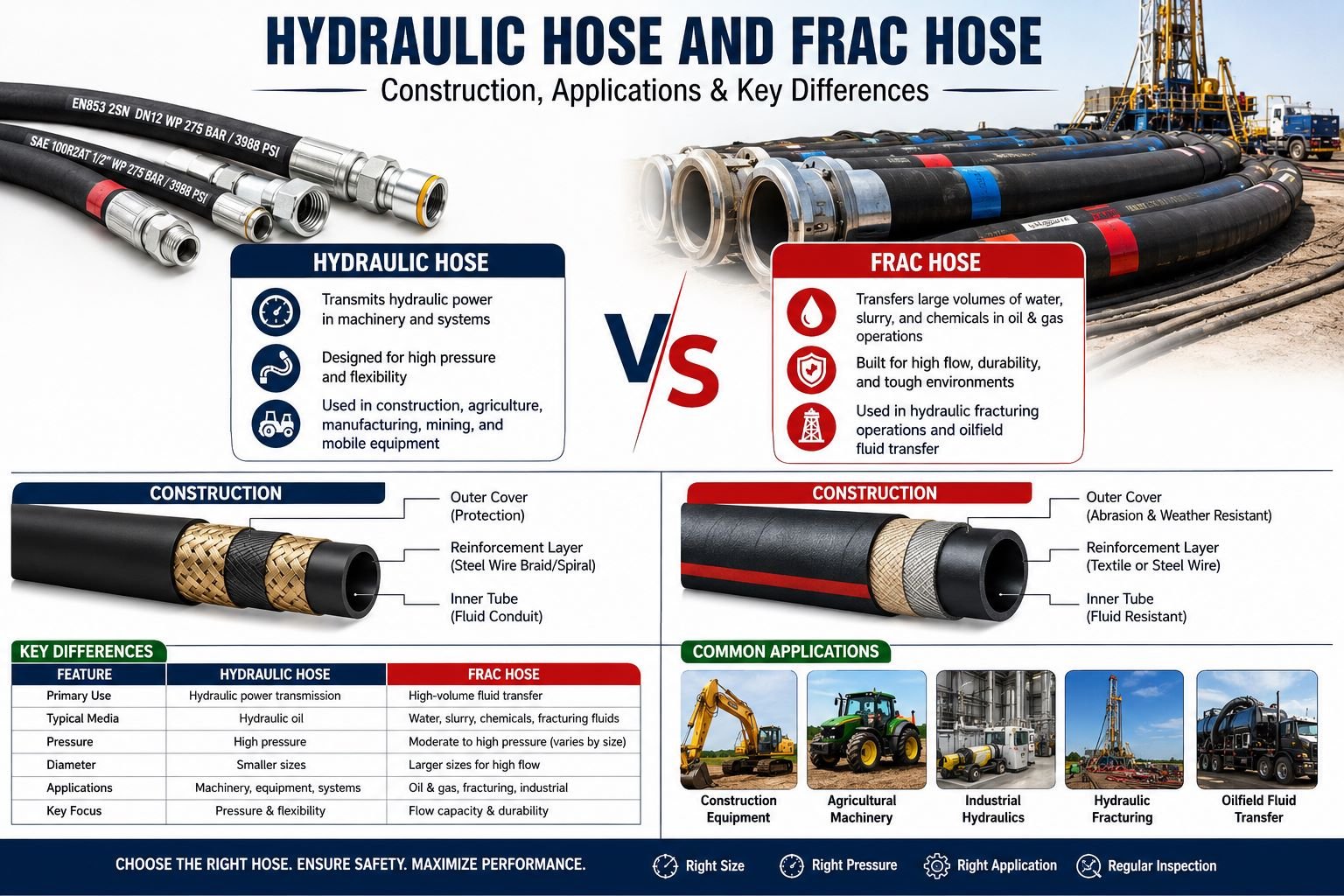
Most hydraulic hoses contain three fundamental layers.
Inner tube: This is the section that directly contacts the hydraulic fluid. Its material needs to be compatible with the fluid being transported.
Reinforcement: The reinforcement provides strength against internal pressure. Depending on the application, it may contain textile material, braided steel wire or spiral steel wire.
Outer cover: This layer protects the internal structure against abrasion, oil, weather and environmental exposure.
Different combinations of these materials produce hoses suitable for different pressure ranges and working environments.
Where Does Frac Hose Fit into the Picture?
A frac hose serves a different industrial environment.
Hydraulic fracturing operations require considerable fluid movement between storage, blending, pumping and wellsite equipment. Flexible hoses can provide practical connections between different parts of these fluid-handling systems.
Depending on its specification and intended service, a frac hose may be used with:
- Water
- Fracturing fluids
- Chemical mixtures
- Slurry
- Compatible oilfield fluids
Large-volume transfer is often an important consideration.
The exact pressure rating, hose diameter, lining material and reinforcement must therefore correspond with the particular application rather than assuming every frac hose performs the same function.
Why Oilfield Conditions Put Frac Hose to the Test
Oilfield environments can be demanding on equipment.
A frac hose may encounter dirt, rough ground, frequent movement, changing temperatures, sunlight, chemicals and abrasive materials. Its outer cover and reinforcement therefore need to suit the environment in which the hose will actually operate.
Imagine a hose that performs perfectly when stationary but is regularly dragged across rough surfaces at the job site. External abrasion may eventually damage its cover and expose the reinforcement.
This is why application conditions matter just as much as pressure ratings.
Hydraulic Hose vs Frac Hose: What Is the Difference?
| Factor | Hydraulic Hose | Frac Hose |
| Primary role | Transfers hydraulic power fluid | Transfers oilfield process fluids |
| Typical application | Machinery and equipment | Fracturing and wellsite operations |
| Typical media | Hydraulic oil and compatible fluids | Water, slurry, chemicals and compatible frac fluids |
| Flow requirement | Based on hydraulic circuit | Often high-volume transfer |
| Environment | Industrial/mobile machinery | Harsh outdoor field conditions |
| Key considerations | Pressure, flexibility, temperature | Flow, abrasion, media compatibility |
| Common sizes | Application dependent | Frequently larger for bulk transfer |
The two categories should not be considered automatically interchangeable.
Pressure Is More Than Just a Number on the Hose
Pressure rating is one of the first specifications buyers normally check, and for good reason.
A Hydraulic Hose must withstand the operating pressure of the hydraulic circuit. Systems can also experience pressure pulses or temporary spikes during operation.
The same careful approach applies when specifying a frac hose.
It is important to distinguish between working pressure and burst pressure. Burst pressure should never be treated as the normal operating pressure of a hose.
Incorrect pressure selection can contribute to:
- Leakage
- Hose deformation
- Reinforcement damage
- Fitting problems
- Unexpected failure
- Equipment downtime
Always follow the hose manufacturer’s specifications and relevant engineering requirements.
Bigger Is Not Always Better: Why Hose Size Matters
Hose diameter affects fluid velocity and pressure loss.
If a Hydraulic Hose has an internal diameter that is too small, fluid may travel through it at excessive velocity. The result can be unnecessary pressure loss, heat generation and reduced system efficiency.
With a frac hose, sizing becomes especially important when substantial volumes of fluid must be transferred.
Engineers generally consider:
- Flow requirement
- Internal diameter
- Fluid properties
- Hose length
- Operating pressure
- Acceptable pressure loss
The objective is not to select the largest hose possible, but the correct hose for the required flow.
The Fluid Inside the Hose Matters Too
A hose suitable for one fluid may not necessarily work with another.
The inner tube must be chemically compatible with the media passing through it. Otherwise, the material could swell, soften, harden or deteriorate.
For hydraulic machinery, this means checking compatibility with the hydraulic oil or other system fluid.
For a frac hose, the question may be more complicated because water, additives, chemicals and abrasive solids can form part of the fluid-transfer process.
Before purchasing, provide the supplier with accurate information about the intended media.
Heat, Cold and the Working Environment
Temperature is another factor that is easy to overlook.
The temperature of the fluid and the surrounding environment both matter.
A Hydraulic Hose positioned close to an engine or exhaust system can experience considerable external heat. Similarly, hoses operating outdoors can be exposed to changing weather conditions.
Operating outside the recommended temperature range may accelerate deterioration.
Heat shields, protective sleeves or alternative routing may be appropriate where unavoidable external heat sources exist.
Why Proper Hose Routing Extends Service Life
Even a high-quality hose can experience premature problems when installed incorrectly.
Common routing mistakes include:
- Twisting the hose
- Creating excessively tight bends
- Allowing continuous rubbing
- Stretching the assembly
- Positioning it against sharp edges
- Routing too close to heat sources
- Allowing unnecessary movement
Every hose has a recommended minimum bend radius. Installing it below that limit can place excessive stress on the reinforcement.
A properly routed Hydraulic Hose should accommodate equipment movement without unnecessary tension.
Never Overlook the Fittings
A hose assembly is only as reliable as its connections.
The fittings must match the hose construction, pressure requirements and equipment interface.
For hydraulic assemblies, crimping is particularly important. The hose and fitting should form a compatible assembly according to the manufacturer’s specifications.
Mixing components without confirming compatibility can create unnecessary risk.
The same principle applies to frac hose connections, where reliable coupling systems are essential during demanding fluid-transfer operations.
Signs That a Hose Needs Attention
Preventive inspection is far better than waiting for a hose to fail unexpectedly.
Look for warning signs such as:
- Cracks in the cover
- Deep abrasion
- Fluid leakage
- Blisters
- Kinks
- Exposed reinforcement
- Corroded fittings
- Damaged couplings
- Unusual deformation
- Excessive stiffness
A damaged high-pressure Hydraulic Hose should be treated seriously. Fluid escaping under pressure can create significant hazards.
Maintenance and replacement should follow manufacturer recommendations and applicable workplace safety procedures.
How to Choose the Right Hydraulic Hose
Instead of asking, “What hose size do I need?” start with the complete application.
Provide your supplier with information about:
- Internal diameter
- Required length
- Working pressure
- Fluid type
- Fluid temperature
- Ambient temperature
- Required flow
- Bend requirements
- Fitting type
- Equipment movement
- Abrasion exposure
The more accurate the application information, the easier it becomes to identify a suitable Hydraulic Hose.
How to Select a Suitable Frac Hose
For a frac hose, selection should begin with the actual field conditions.
Ask practical questions.
What fluid will pass through the hose? Does it contain abrasive particles? What volume must be transferred? What working pressure is expected? Will the hose be moved regularly? Will it be exposed to rough surfaces or extreme weather?
These questions help determine appropriate:
- Hose diameter
- Inner lining
- Reinforcement
- Cover material
- Pressure capability
- Couplings
- Length
This application-based approach is more reliable than choosing a product solely from a catalogue description.
Why Buying the Cheapest Hose Can Become Expensive
Purchase price is visible immediately. The cost of failure is not.
Suppose an inexpensive hose requires frequent replacement. The business may also face labour costs, equipment downtime, lost production and fluid cleanup.
A better purchasing decision considers total operational value.
A correctly specified Hydraulic Hose or frac hose can support reliable operation, predictable maintenance and improved equipment availability.
That does not mean the most expensive hose is automatically best. It means the hose should match the application.
Frequently Asked Questions About Hydraulic Hose and Frac Hose
1. What does a Hydraulic Hose do?
It carries pressurised hydraulic fluid between pumps, valves, cylinders, motors and other components in hydraulic equipment.
2. What is a frac hose?
A frac hose is designed for fluid-transfer applications associated with hydraulic fracturing and other oilfield operations.
3. Are hydraulic and frac hoses interchangeable?
Not automatically. Their pressure, diameter, materials, reinforcement and intended applications can differ.
4. What fluids can hydraulic hoses carry?
They can handle fluids compatible with their inner tube material and manufacturer specifications, including various hydraulic fluids.
5. Why does hydraulic hose diameter matter?
Diameter influences fluid velocity, pressure drop, heat generation and overall hydraulic system performance.
6. What causes a Hydraulic Hose to burst?
Possible causes include excessive pressure, ageing, abrasion, incorrect installation, reinforcement damage or unsuitable application conditions.
7. Can a frac hose handle abrasive slurry?
Certain hoses are designed for abrasive media, but compatibility must be confirmed from the manufacturer’s specifications.
8. How often should industrial hoses be inspected?
Inspection intervals should reflect operating severity, manufacturer recommendations, applicable standards and the organisation’s maintenance programme.
9. What is minimum bend radius?
It is the smallest recommended radius through which a hose should be bent without placing excessive stress on its construction.
10. How do I know which hose fitting I need?
Identify the equipment connection, thread or coupling type, pressure requirement, hose specification and manufacturer’s fitting recommendations.
Read more – https://newsgrow.blogspot.com/2026/08/hydraulic-hose-manufacturer-and.html
https://newsgrow.blogspot.com/2026/08/hydraulic-hose-and-frac-hose-deep.html