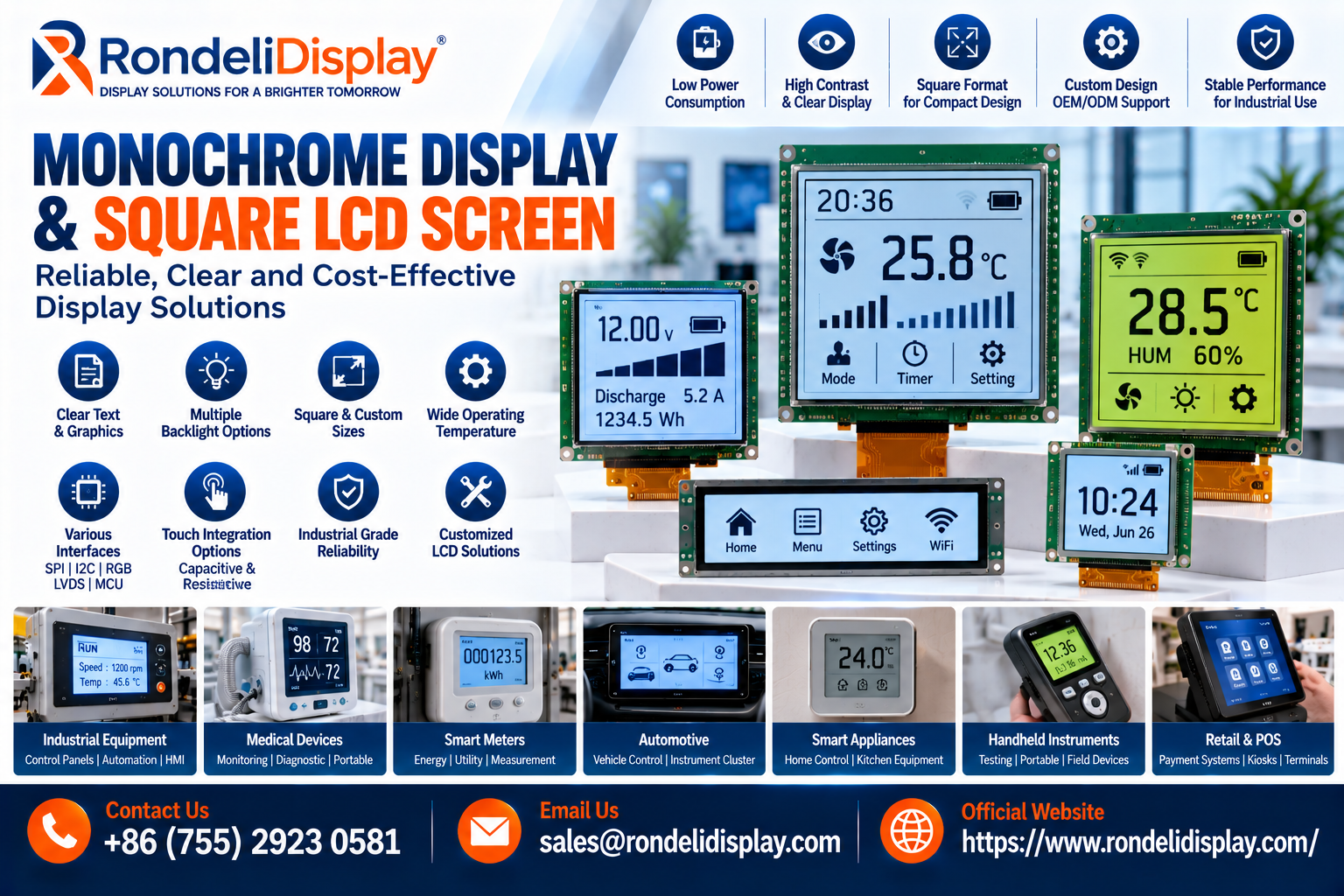
Industrial equipment manufacturers are giving greater attention to the way critical information appears on electronic screens. In laboratories, manufacturing facilities, environmental monitoring stations, and automated equipment, operators often need to identify measurements, warnings, and operating conditions quickly.
A Monochrome Display can provide a straightforward interface for presenting numerical readings, symbols, and essential operating information without unnecessary visual complexity.
Meanwhile, a Square LCD Screen offers a balanced display format suitable for compact instruments, control panels, and monitoring devices.
These display characteristics serve different purposes but can complement one another in suitably designed equipment.
For original equipment manufacturers, electronics developers, and industrial technology buyers, the priority is creating interfaces that communicate important information clearly while remaining practical to manufacture and maintain.
Why Clear Information Matters in Industrial Monitoring
Industrial monitoring equipment may display temperatures, pressure readings, operational states, or equipment alerts.
When information is difficult to interpret, operators may need additional time to understand what a machine is reporting.
A carefully designed interface can make important readings easier to identify.
For example, a measurement instrument may benefit from displaying its main reading prominently while placing secondary information in smaller sections.
This principle supports simpler layouts and more purposeful display selection.
What Is a Monochrome Display?
A Monochrome Display is an electronic screen that presents visual information using a single colour or shades of one colour.
In LCD applications, monochrome technology may use segmented or dot-matrix structures.
Segmented displays are useful for predefined numbers, letters, and symbols.
Dot-matrix displays provide greater flexibility for presenting graphics, text, and changing interface arrangements.
Depending on the construction, monochrome LCDs can be reflective, transmissive, or transflective.
Each design has different illumination and readability characteristics.
Manufacturers should select the configuration according to the equipment’s intended environment and information requirements.
Understanding the Advantages of a Square LCD Screen
A Square LCD Screen features approximately equal horizontal and vertical dimensions.
This geometry can be useful when an electronic product requires a centred layout or symmetrical arrangement of information.
For example, a compact monitoring device might place a numerical reading in the centre, with operating symbols around its edges.
Square screens can also suit equipment enclosures where conventional widescreen displays would create unnecessary unused space.
However, square geometry does not determine display technology.
Depending on the product, a square LCD may support monochrome or colour graphics.
The appropriate choice depends on the required interface.
Why Alert Visibility Deserves Special Attention
Equipment monitoring displays frequently communicate both routine information and unusual operating conditions.
Warnings should be distinguishable from ordinary measurements.
A monochrome interface can use symbols, text, changes in contrast, and suitable visual indicators to communicate different operating states.
However, important warnings should not rely exclusively on flashing graphics or subtle differences in appearance.
Clear wording and consistent symbol placement can help users recognise relevant conditions.
Where safety is involved, display warnings should complement appropriate independent protective systems.
Reflective, Transmissive, and Transflective LCDs
Monochrome LCDs can be designed with different lighting arrangements.
| LCD Type | Main Characteristic | Suitable Consideration |
| Reflective LCD | Uses ambient light for visibility | Well-lit environments and suitable low-power applications |
| Transmissive LCD | Uses backlighting for display visibility | Equipment requiring controlled illumination |
| Transflective LCD | Combines reflective and backlit viewing characteristics | Applications involving changing lighting conditions |
No configuration performs best under every lighting condition.
Manufacturers should evaluate actual viewing environments, backlight requirements, and screen contrast before selecting a panel.
How Display Layout Influences Operator Efficiency
A display’s usefulness depends on how information is arranged.
Crowded screens can make important details difficult to locate.
A square format encourages designers to consider balanced layouts with clearly defined information areas.
For example, a laboratory instrument may display its principal measurement centrally, supporting units beneath it and operating status along the outer edges.
However, symmetrical design should not become more important than readability.
Typography, spacing, symbol recognition, and appropriate information hierarchy remain essential.
The interface should support the operator’s actual tasks.
Environmental Conditions and Display Reliability
Industrial displays may operate under changing temperatures, vibration, humidity, or electrical conditions.
These factors can influence display performance.
For liquid crystal technology, temperature may affect response characteristics and contrast.
Manufacturers should verify the specified operating temperature range and suitable mounting arrangements.
Environmental protection may also depend on the equipment enclosure rather than the LCD module alone.
A display intended for a laboratory instrument may require different protections from one installed in outdoor monitoring equipment.
Appropriate testing helps establish whether the complete assembly meets its application requirements.
Electrical Integration and Controller Compatibility
Display integration requires matching the screen with the host electronic system.
Depending on the module, designers may need to consider controller compatibility, communication interfaces, voltage requirements, and available graphics memory.
Some monochrome graphic LCD modules support serial interfaces, while other designs use different electrical connections.
Developers should review the actual module documentation before finalising circuit layouts.
Incorrect interface assumptions can lead to unnecessary redesign work.
Early prototype testing helps verify electrical operation and displayed information.
Quality Control for Instrument Display Manufacturing
Display quality should be evaluated according to the intended equipment.
Relevant checks may include visual appearance, contrast, pixel or segment functionality, dimensional accuracy, and electrical operation.
Manufacturers should also inspect connectors and mounting features.
Where equipment requires repeated production, approved reference samples can support consistent inspection.
Quality-control procedures should distinguish cosmetic imperfections from defects affecting operation.
Clear acceptance criteria help suppliers and buyers maintain shared expectations.
Selecting a Suitable LCD Supplier
Businesses evaluating specialised display manufacturers should consider:
- Display Configuration: Confirm segmented or graphic monochrome requirements.
- Screen Geometry: Review active area, dimensions, and resolution.
- Illumination: Select appropriate reflective, transmissive, or transflective construction.
- Electrical Compatibility: Verify interfaces and operating requirements.
- Environmental Performance: Review temperature and reliability specifications.
- Customisation: Confirm available symbols, connectors, and mechanical configurations.
A suitable supplier should provide technical documentation and representative samples for product evaluation.
Frequently Asked Questions (FAQs)
1. What is a Monochrome Display?
A monochrome display presents information using one colour or shades of a single colour, making it suitable for numerical, graphical, and status-oriented interfaces.
2. What is a Square LCD Screen?
A square LCD screen is a liquid crystal display with approximately equal horizontal and vertical dimensions, often used in compact electronic equipment.
3. Why are monochrome LCDs used in industrial instruments?
They can provide clear numerical information, straightforward interfaces, and suitable electrical characteristics for specialised monitoring applications.
4. Can a square LCD display show warning symbols?
Yes. Compatible square graphic or segmented LCDs can present warning symbols, status indicators, and numerical readings according to their design.
5. How should equipment manufacturers choose LCD displays?
Manufacturers should consider readability, dimensions, electrical compatibility, environmental conditions, power requirements, and supplier documentation.
Media Contact
Department: Industrial LCD and Custom Display Enquiries
Email: sales@rondelidisplay.com
Official Website: https://www.rondelidisplay.com/