Advanced manufacturing industries are increasingly focusing on material purity, thermal stability, and precision engineering when selecting components for demanding production environments. From metal processing and laboratory research to semiconductor-related applications, specialised ceramic materials play an important role in improving process control.
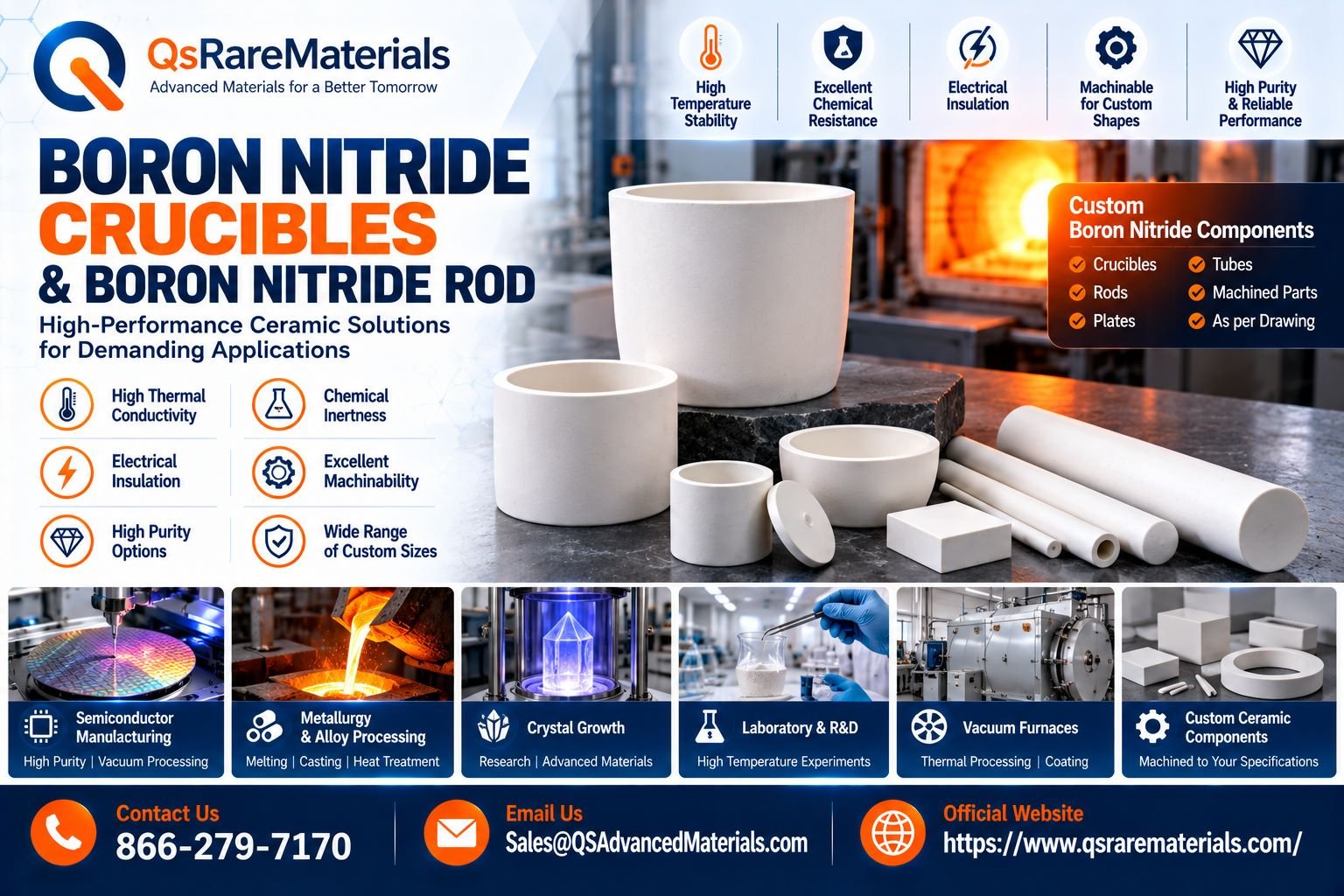
Boron Nitride Crucibles are attracting attention for selected high-temperature applications where suitable thermal properties, chemical compatibility, and controlled material handling are essential.
Meanwhile, a Boron Nitride Rod provides a versatile ceramic form that can be machined or incorporated into specialised components for thermal and electrical applications.
Although both products belong to the boron nitride material family, their functions, manufacturing requirements, and performance considerations differ.
For research laboratories, industrial manufacturers, and advanced materials buyers, understanding these distinctions is essential for selecting appropriate ceramic components.
Why High-Purity Materials Matter in Advanced Manufacturing
Material contamination can create challenges in processes requiring controlled chemical composition and consistent product quality.
In metal processing, for example, reactions between a molten material and its container may influence the final product.
Similarly, specialised electronic manufacturing applications may require components that minimise unwanted material interactions.
Advanced ceramics offer potential solutions when selected according to the process conditions.
However, no ceramic material is universally resistant to every chemical or operating environment.
This principle makes material composition and application testing important purchasing considerations.
What Are Boron Nitride Crucibles?
Boron Nitride Crucibles are specialised ceramic containers manufactured from suitable boron nitride materials for selected laboratory and industrial processing applications.
Depending on the material grade and construction, they may offer thermal stability, electrical insulation, and relatively low wettability with certain molten materials.
These characteristics can make them useful for selected melting, evaporation, and materials research processes.
However, performance depends on several factors, including material purity, temperature, atmosphere, and chemical compatibility.
Different boron nitride grades may contain binders or have distinct manufacturing structures.
Consequently, buyers should verify technical specifications before selecting crucibles for critical applications.
Understanding the Importance of Boron Nitride Rod
A Boron Nitride Rod is a solid cylindrical ceramic product manufactured from a suitable boron nitride material.
Rods can serve as stock material for producing customised components, depending on grade and machining characteristics.
Potential applications include insulating parts, support elements, spacers, fixtures, and specialised thermal-processing components.
Some machinable hexagonal boron nitride grades allow precise shaping using appropriate equipment.
However, mechanical strength varies by material grade, manufacturing method, and loading direction.
Boron nitride rods should not automatically be considered suitable for heavy structural loads.
Material selection must reflect the intended mechanical and thermal conditions.
The Role of Thermal Performance in Ceramic Selection
High-temperature processing introduces challenges involving temperature variation, expansion, and component stability.
Certain boron nitride ceramics offer useful thermal conductivity and resistance to thermal shock under appropriate conditions.
These properties can support applications where materials experience changing temperatures.
However, thermal performance differs between boron nitride grades and can be direction-dependent.
Furthermore, oxidation in air may limit high-temperature use, even when a material performs well in vacuum or an inert atmosphere.
This helps engineers avoid relying on incomplete performance claims.
Crucibles and Rods: Different Forms, Different Functions
Although crucibles and rods may use related ceramic materials, their practical purposes are different.
| Evaluation Factor | Boron Nitride Crucibles | Boron Nitride Rod |
| Primary Function | Containing suitable materials during processing | Producing or supporting specialised components |
| Common Geometry | Open container or vessel | Solid cylindrical form |
| Important Property | Chemical compatibility with contained material | Machinability and dimensional suitability |
| Typical Application | Selected melting and evaporation processes | Insulators, spacers, fixtures and machined parts |
| Quality Consideration | Wall uniformity and material purity | Dimensional accuracy and structural integrity |
| Selection Priority | Process temperature and chemical environment | Mechanical, electrical and thermal requirements |
Understanding the intended function is essential before comparing product specifications.
Why Chemical Compatibility Cannot Be Overlooked
One of the most important considerations in ceramic selection is how a material interacts with substances during processing.
Boron nitride may demonstrate low wettability with certain molten metals, making selected grades useful in specialised applications.
However, behaviour varies with melt composition, impurities, temperature, and operating atmosphere.
A crucible suitable for one process may be unsuitable for another.
Manufacturers and laboratories should evaluate chemical compatibility using relevant technical documentation and representative testing.
This is particularly important when processing valuable materials or conducting experiments where contamination could affect results.
Precision Machining and Custom Ceramic Components
Advanced equipment often requires ceramic parts with specific dimensions and geometries.
Suitable boron nitride rod stock can be machined into components according to engineering drawings.
Potential features include holes, grooves, stepped profiles, and other geometries permitted by the chosen grade.
However, machining requires attention to tolerances, material orientation, and component fragility.
Improper handling can introduce cracks or surface defects.
Businesses should provide detailed drawings and clearly defined operating requirements when requesting customised ceramic components.
Prototype evaluation can help confirm fit and performance before larger production orders.
Quality Control for High-Performance Boron Nitride Products
Material quality can influence processing consistency and component reliability.
Relevant quality considerations may include chemical composition, density, porosity, dimensions, and visible defects.
For crucibles, wall thickness and surface condition may be important.
For rods, buyers may prioritise dimensional accuracy, straightness, and machining quality.
Material certificates and inspection reports can provide useful information where available.
However, technical documentation should identify the relevant material grade and test conditions.
Buyers should not assume that all boron nitride products have identical performance characteristics.
Industrial Applications of Boron Nitride Ceramics
Boron nitride ceramics can support several specialised applications:
- Materials Research: Selected experiments involving controlled thermal environments and compatible materials.
- Metal Processing: Suitable crucibles and components for particular molten-metal applications.
- Semiconductor-Related Equipment: Specialised insulating or processing components where technical requirements permit.
- Thermal Systems: Ceramic parts requiring appropriate thermal and electrical properties.
- Precision Engineering: Machined components for specialised industrial equipment.
Each application requires confirmation of material suitability, operational conditions, and relevant safety requirements.
Choosing the Right Boron Nitride Supplier
Businesses sourcing technical ceramics should evaluate manufacturers and distributors according to their engineering requirements.
Important considerations include:
- Material Grade: Confirm composition, purity, and manufacturing characteristics.
- Temperature Requirements: Assess performance under the intended atmosphere.
- Chemical Compatibility: Verify suitability for contacting materials.
- Dimensional Accuracy: Review machining capabilities and tolerances.
- Quality Documentation: Request relevant technical and inspection information.
- Customisation Support: Evaluate the ability to supply specialised shapes and components.
A suitable supplier should communicate both material capabilities and limitations clearly.
Frequently Asked Questions (FAQs)
1. What are Boron Nitride Crucibles used for?
Boron nitride crucibles are used in selected high-temperature processes, including materials research and compatible melting or evaporation applications.
2. What is a Boron Nitride Rod?
A boron nitride rod is a cylindrical ceramic material that can be used directly or machined into suitable specialised components.
3. Are boron nitride crucibles suitable for all molten metals?
No. Suitability depends on the molten material, ceramic grade, processing temperature, and operating atmosphere.
4. Can boron nitride rods be machined into custom parts?
Certain machinable boron nitride grades can be shaped into customised components using appropriate equipment and engineering procedures.
5. What should buyers check before purchasing boron nitride ceramics?
Buyers should verify material purity, grade, thermal properties, chemical compatibility, dimensional requirements, and relevant technical documentation.
Media Contact
Department: Advanced Ceramic Materials and Technical Product Enquiries
Contact : 866-279-7170
Email : Sales@QSAdvancedMaterials.com
Official Website : https://www.qsrarematerials.com/