From steel service centres to fabrication workshops, equipment performance affects production efficiency, product quality, and workplace safety.
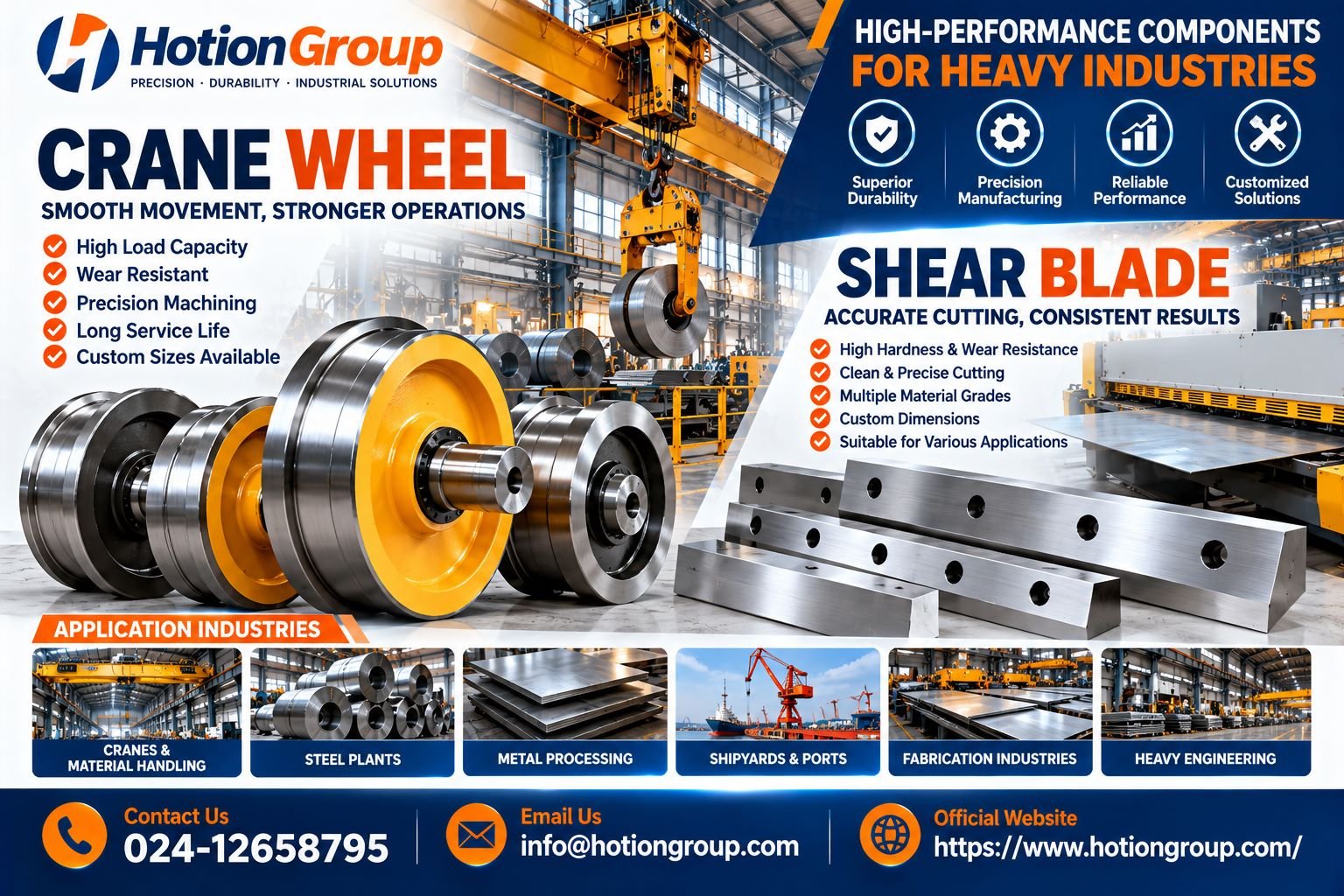
A Crane Wheel plays a critical role in supporting and guiding cranes along designated travel systems, enabling controlled movement of heavy loads.
Meanwhile, a Shear Blade is an important cutting component used in suitable metal-shearing equipment to separate sheets, plates, bars, and other materials according to machine design.
Although these components perform different functions, both contribute to the overall reliability of industrial production.
For manufacturers, steel processors, machinery operators, and engineering businesses, understanding their design and operating requirements can support better maintenance decisions and efficient material handling.
Why Material Movement and Cutting Must Work Together
Metal-processing operations involve several interconnected activities.
Raw materials are received, moved into position, processed, inspected, and prepared for further manufacturing or distribution.
Cranes help handle heavy materials, while shearing machines perform controlled cutting operations.
Problems in either process can interrupt downstream production.
For example, unreliable crane movement can delay material positioning, while worn cutting blades may produce unacceptable edges.
This highlights the importance of evaluating equipment components as part of the complete production workflow.
What Is a Crane Wheel?
A Crane Wheel is a mechanical component used to support and guide crane movement along rails or other designated travel arrangements.
Crane wheels may be found in overhead travelling cranes, gantry cranes, and suitable industrial material-handling systems.
Their performance depends on factors such as wheel diameter, material properties, load capacity, rail compatibility, and operating conditions.
Different crane configurations require different wheel designs.
Some arrangements use flanged wheels for guidance, while others incorporate alternative guidance systems.
Correct wheel selection is essential because excessive loading, poor alignment, or unsuitable materials can contribute to premature wear and operational hazards.
Understanding the Function of a Shear Blade
A Shear Blade is a cutting tool used in mechanical or hydraulic shearing equipment.
Shearing separates material by applying force through appropriately positioned cutting edges.
The process is commonly used for metal sheets, plates, and other suitable products.
Cutting performance depends on blade geometry, material hardness, cutting clearance, workpiece properties, and equipment condition.
A properly selected blade helps produce cuts that meet the required specifications.
However, no blade material is suitable for every metal or thickness.
Manufacturers should evaluate tooling according to the intended machine, workpiece material, and cutting conditions.
Why Crane Wheel Alignment Matters
Crane wheel alignment influences how a crane travels along its designated track.
Misalignment can create uneven contact between wheels and rails.
This may contribute to excessive flange wear, abnormal vibration, or increased mechanical stress.
Crane operators should investigate unusual travel behaviour through approved maintenance procedures.
Relevant inspections may include wheel condition, track geometry, bearing performance, and mechanical alignment.
However, adjustments must be performed by qualified personnel following equipment-specific safety requirements.
Maintaining appropriate alignment can support safer operation and reduce avoidable component deterioration.
How Shear Blade Quality Influences Cutting Results
The quality of a cutting edge can directly affect the condition of a sheared metal surface.
Worn, chipped, or incorrectly adjusted blades may contribute to excessive burr formation, distortion, or inconsistent cutting.
Blade material and heat treatment influence wear resistance and toughness.
Hardness is important, but an excessively brittle blade may suffer damage under unsuitable cutting conditions.
Correct cutting clearance is also essential.
Manufacturers should follow machine and tooling specifications rather than relying on arbitrary adjustments.
Regular blade inspection can help identify deterioration before it affects larger quantities of material.
Comparing Crane Wheels and Shear Blades
| Evaluation Factor | Crane Wheel | Shear Blade |
| Primary Function | Supports and guides crane movement | Cuts suitable industrial materials |
| Common Equipment | Overhead and gantry cranes | Mechanical and hydraulic shears |
| Important Properties | Strength, toughness, wear resistance | Hardness, toughness, edge durability |
| Performance Concern | Load distribution and alignment | Cutting quality and blade clearance |
| Typical Wear | Tread wear and flange deterioration | Edge dulling, chipping, or damage |
| Maintenance Priority | Wheel, bearing, and rail inspection | Edge inspection and tooling condition |
Both components require appropriate material selection and inspection, but their performance must be evaluated against different engineering criteria.
Material Selection and Component Manufacturing
Industrial equipment components experience significant mechanical stresses.
Crane wheels may be manufactured from suitable steel grades and undergo controlled processing or heat treatment to achieve the required properties.
Their design must account for operating loads and contact conditions.
Shear blades may use specialised tool steels or other appropriate materials selected according to the cutting application.
Material selection should consider toughness, hardness, wear behaviour, and dimensional requirements.
Manufacturers should verify the applicable specifications instead of assuming that a higher hardness rating always means better performance.
The correct balance of properties depends on the intended operating conditions.
Preventive Maintenance in Metal-Processing Facilities
Maintenance programmes help facilities identify component deterioration before it results in major equipment problems.
For crane systems, relevant inspections may focus on wheel wear, bearings, abnormal noises, and rail condition.
For shearing equipment, inspections may include blade edges, mounting arrangements, cutting clearance, and associated machine components.
All maintenance should follow approved safety procedures.
Heavy equipment must be appropriately secured and hazardous energy isolated before servicing.
Cutting equipment must never be adjusted while its moving mechanisms present an uncontrolled hazard.
Documented inspection findings can support maintenance planning and component replacement decisions.
How Better Component Selection Supports Production Efficiency
Purchasing decisions should consider more than the initial price of replacement parts.
An unsuitable component can create additional maintenance expenses and production interruptions.
Industrial buyers should establish clear requirements for dimensions, materials, operating loads, and equipment compatibility.
Relevant technical drawings and manufacturer specifications can support accurate procurement.
Where practical, suppliers should provide appropriate quality documentation and inspection information.
Careful component selection can help businesses maintain more consistent operating conditions.
It also reduces the likelihood of purchasing parts that cannot be installed or used as intended.
Choosing a Reliable Industrial Component Supplier
Manufacturers evaluating component suppliers should focus on technical suitability and production consistency.
Important considerations include:
- Engineering Specifications: Confirm dimensions, tolerances, and operating requirements.
- Material Quality: Review suitable material grades and available documentation.
- Manufacturing Capability: Assess machining, heat treatment, and inspection processes where applicable.
- Equipment Compatibility: Verify suitability for the intended machinery.
- Quality Assurance: Review relevant inspection and acceptance procedures.
- Technical Communication: Confirm the supplier can address product-specific requirements.
A structured evaluation helps procurement teams make informed purchasing decisions.
Frequently Asked Questions (FAQs)
1. What is a Crane Wheel used for?
A crane wheel supports and guides crane movement along designated rails or travel systems in suitable material-handling equipment.
2. What is a Shear Blade?
A shear blade is a cutting component used in industrial shearing machines to separate metal or other appropriate materials through controlled shearing force.
3. What causes excessive crane wheel wear?
Possible causes include unsuitable loading, misalignment, rail problems, material incompatibility, and inadequate maintenance.
4. Why is shear blade material important?
Blade material influences hardness, toughness, wear resistance, and cutting-edge durability under specific operating conditions.
5. How should businesses choose industrial machinery components?
Buyers should evaluate technical specifications, material properties, equipment compatibility, manufacturing quality, safety requirements, and supplier capabilities.
Media Contact
Department: Industrial Machinery and Metal-Processing Component Enquiries
Contact: 024-12658795
Email: info@hotiongroup.com
Official Website: https://www.hotiongroup.com/
Read More:-