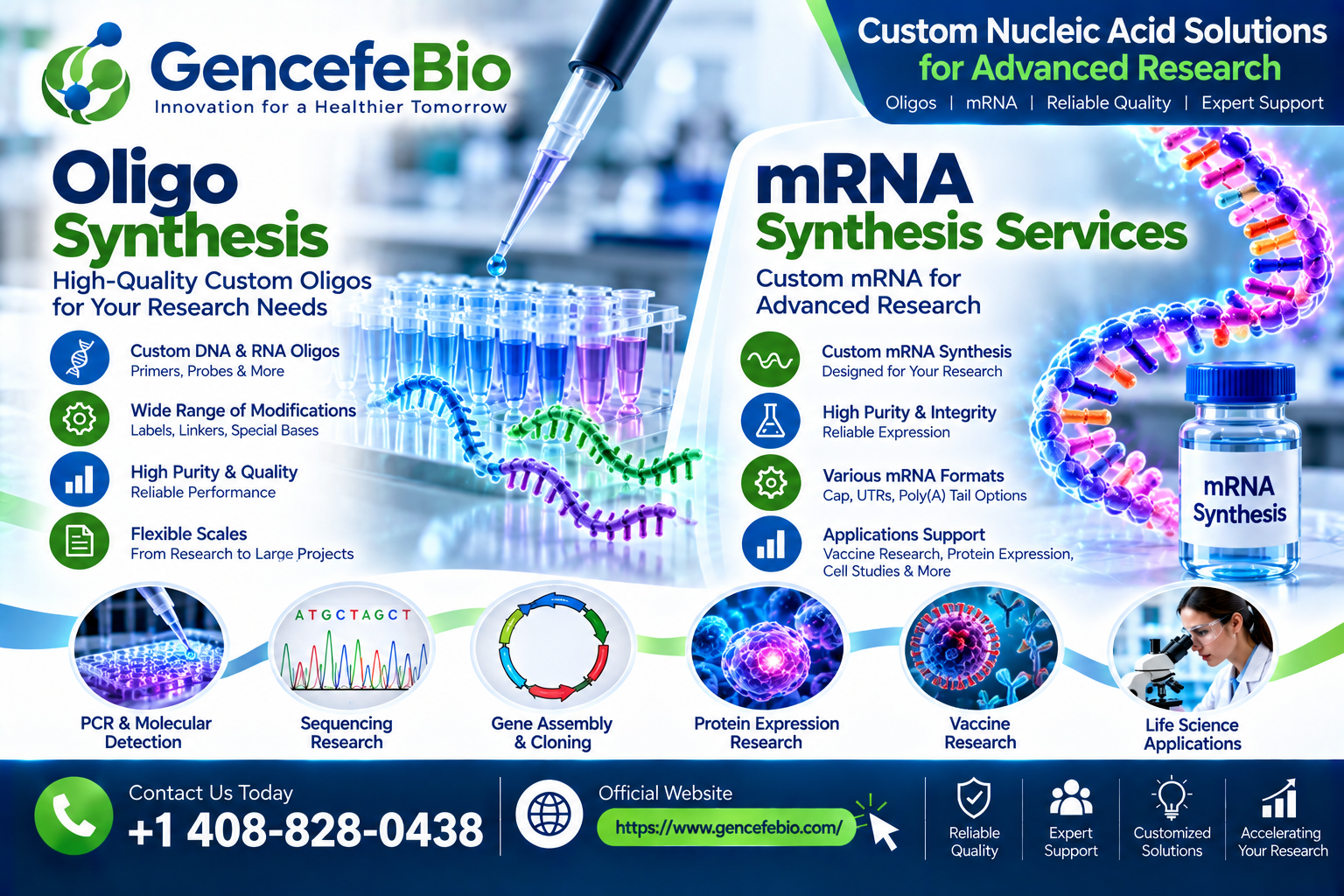
As advances in molecular biology, genomics, and RNA-based technologies create new opportunities for scientific discovery, researchers are placing greater emphasis on reliable nucleic acid production. Oligo synthesis supports the development of sequence-specific DNA and RNA molecules, while mRNA synthesis services provide customized messenger RNA materials for gene expression studies, protein research, and emerging biotechnology applications.
From pharmaceutical research laboratories to academic institutions and biotechnology companies, synthetic nucleic acids have become important tools for understanding biological functions and developing innovative molecular technologies.
Research organizations are increasingly considering sequence accuracy, molecular integrity, purity, and analytical documentation when selecting nucleic acid synthesis solutions.
Growing Importance of Oligo Synthesis in Modern Biotechnology
Oligonucleotides are short sequences of DNA or RNA designed for specific research applications. These molecules play important roles in molecular detection, genetic analysis, and experimental nucleic acid technologies.
Oligo synthesis refers to the chemical production of oligonucleotides according to specified nucleotide sequences.
Researchers use customized oligonucleotides in applications such as:
- PCR and quantitative PCR research.
- DNA sequencing and genetic analysis.
- Molecular probe development.
- Gene expression investigations.
- RNA interference research.
- Synthetic biology studies.
- Molecular assay development.
The appropriate oligonucleotide depends on its sequence, length, chemical modifications, and experimental requirements.
Accurately characterized oligonucleotides help researchers develop experiments based on known molecular specifications.
What Is Oligo Synthesis?
Oligo synthesis is the laboratory process of producing short DNA or RNA molecules with predetermined nucleotide sequences.
Chemical synthesis methods allow researchers to obtain oligonucleotides for specialized molecular biology applications.
Depending on the product, synthesized oligonucleotides may include modifications designed to support particular research functions.
Common Types of Synthetic Oligonucleotides
DNA Oligonucleotides: Frequently used as primers and probes in molecular biology.
RNA Oligonucleotides: Used in suitable RNA research and gene regulation studies.
Modified Oligonucleotides: May incorporate fluorescent labels, biotin, or other chemical modifications.
Specialized Research Oligos: Designed for applications involving gene silencing, molecular recognition, or nucleic acid analysis.
The selection of a suitable product requires consideration of experimental compatibility and analytical specifications.
Understanding mRNA Synthesis Services
mRNA synthesis services involve the production of messenger RNA molecules according to defined genetic sequences and research requirements.
Messenger RNA carries genetic information that cellular machinery can use to produce proteins.
In biotechnology research, synthetic messenger RNA is used to study protein expression, cellular responses, and RNA-based molecular technologies.
Many production workflows use an appropriate DNA template to generate RNA through in vitro transcription.
Depending on the research application, additional processing and characterization may be necessary to obtain the required RNA product.
Major Research Applications
Messenger RNA materials may support:
- Protein expression research.
- Cell biology investigations.
- RNA-based therapeutic discovery.
- Vaccine research and development.
- Molecular signaling studies.
- Experimental biotechnology platforms.
Research-use materials must undergo additional development and qualification before they can be considered suitable for regulated clinical applications.
Key Benefits of Custom Oligonucleotide Production
Custom oligonucleotide production offers researchers flexibility in planning specialized experiments.
Sequence-Specific Design
Researchers can request oligonucleotides corresponding to selected molecular targets.
Chemical Modification Options
Suitable modifications can support experimental detection, molecular labeling, and other research applications.
Flexible Purification Requirements
Different purification approaches can be selected according to product specifications.
Multiple Research Applications
Synthetic oligonucleotides can support experiments across genetics, molecular diagnostics research, biochemistry, and biotechnology.
Analytical Characterization
Appropriate analytical testing helps evaluate product identity, composition, and purity.
These benefits depend on the technical capabilities of the synthesis provider and the complexity of the requested molecule.
Why mRNA Synthesis Matters for Scientific Discovery
Messenger RNA is central to the biological process connecting genetic information with protein production.
Access to synthetic messenger RNA enables researchers to investigate specific gene expression mechanisms and explore experimental applications involving RNA technologies.
Important quality characteristics include transcript identity, RNA integrity, purity, and stability.
Certain applications may also require evaluation of RNA capping, poly(A) tail characteristics, and production-related impurities.
Because RNA can be vulnerable to degradation, appropriate storage and handling are essential.
Oligo Synthesis vs mRNA Synthesis Services: Key Differences
Although both technologies involve synthetic nucleic acids, they differ in product characteristics and typical applications.
| Feature | Oligo Synthesis | mRNA Synthesis Services |
| Primary product | Short DNA or RNA sequences | Messenger RNA molecules |
| Common production approach | Chemical synthesis | Often in vitro transcription |
| Research applications | Primers, probes, gene regulation studies | Protein expression and RNA research |
| Customization | Sequence and chemical modifications | Transcript sequence and structural requirements |
| Quality assessment | Identity, purity, modification accuracy | Integrity, identity, purity, transcript characteristics |
These technologies can complement one another within broader molecular research programs.
Quality Control in Nucleic Acid Manufacturing
Quality control is important for research materials intended for sensitive molecular experiments.
For synthesized oligonucleotides, analytical assessment may involve chromatography and mass spectrometry.
For messenger RNA, quality evaluation may include measurements of concentration, purity, transcript integrity, and relevant process-related impurities.
The required analytical methods depend on product type and intended research use.
Researchers should review available certificates of analysis, product specifications, and supporting documentation before using materials in experiments.
Choosing a Reliable Biotechnology Synthesis Provider
Research institutions should evaluate suppliers according to technical capabilities, quality documentation, and project requirements.
Important considerations include:
- Available DNA and RNA synthesis services.
- Supported product lengths and sequence complexity.
- Chemical modification capabilities.
- Purification and analytical testing options.
- Production quantities and project feasibility.
- Storage, packaging, and shipping requirements.
- Technical support and communication.
For oligo synthesis, customers should clearly define sequence requirements, modifications, and intended applications.
For mRNA synthesis services, researchers should also specify transcript characteristics, analytical expectations, and storage requirements.
Frequently Asked Questions (FAQs)
1. What is oligo synthesis?
Oligo synthesis is the chemical production of short DNA or RNA molecules according to specified nucleotide sequences.
2. What are mRNA synthesis services?
They are specialized services that produce messenger RNA molecules for suitable molecular biology and biotechnology research applications.
3. What is the difference between an oligonucleotide and mRNA?
Oligonucleotides are generally short nucleic acid sequences, while messenger RNA carries genetic information used in protein production.
4. Where are synthetic oligonucleotides commonly used?
They are used in PCR, sequencing, molecular probes, gene regulation research, and assay development.
5. Can oligonucleotides include chemical modifications?
Yes. Depending on technical feasibility, modifications may include fluorescent labeling, biotinylation, and other functional groups.
6. How is messenger RNA commonly synthesized?
Research-grade messenger RNA is often produced through in vitro transcription using a suitable DNA template.
7. Why is oligonucleotide purity important?
Purity can influence assay performance and help reduce interference from unwanted synthesis-related materials.
8. What factors affect mRNA stability?
RNA structure, formulation, storage temperature, handling conditions, and exposure to degrading enzymes can influence stability.
9. What determines nucleic acid synthesis pricing?
Costs depend on sequence complexity, product length, requested quantity, modifications, purification, and analytical requirements.
10. What should researchers check before ordering synthesis services?
Researchers should verify sequence details, product specifications, purity requirements, analytical documentation, storage conditions, and application compatibility.
Media Contact
Industry: Biotechnology, Genomics, RNA Research & Life Sciences
Service Enquiries: Oligonucleotide Synthesis, mRNA Synthesis & Molecular Research Materials
Contact Number: +1 408-828-0438
Email: gene@gencefebio.com
Official Website: https://www.gencefebio.com/