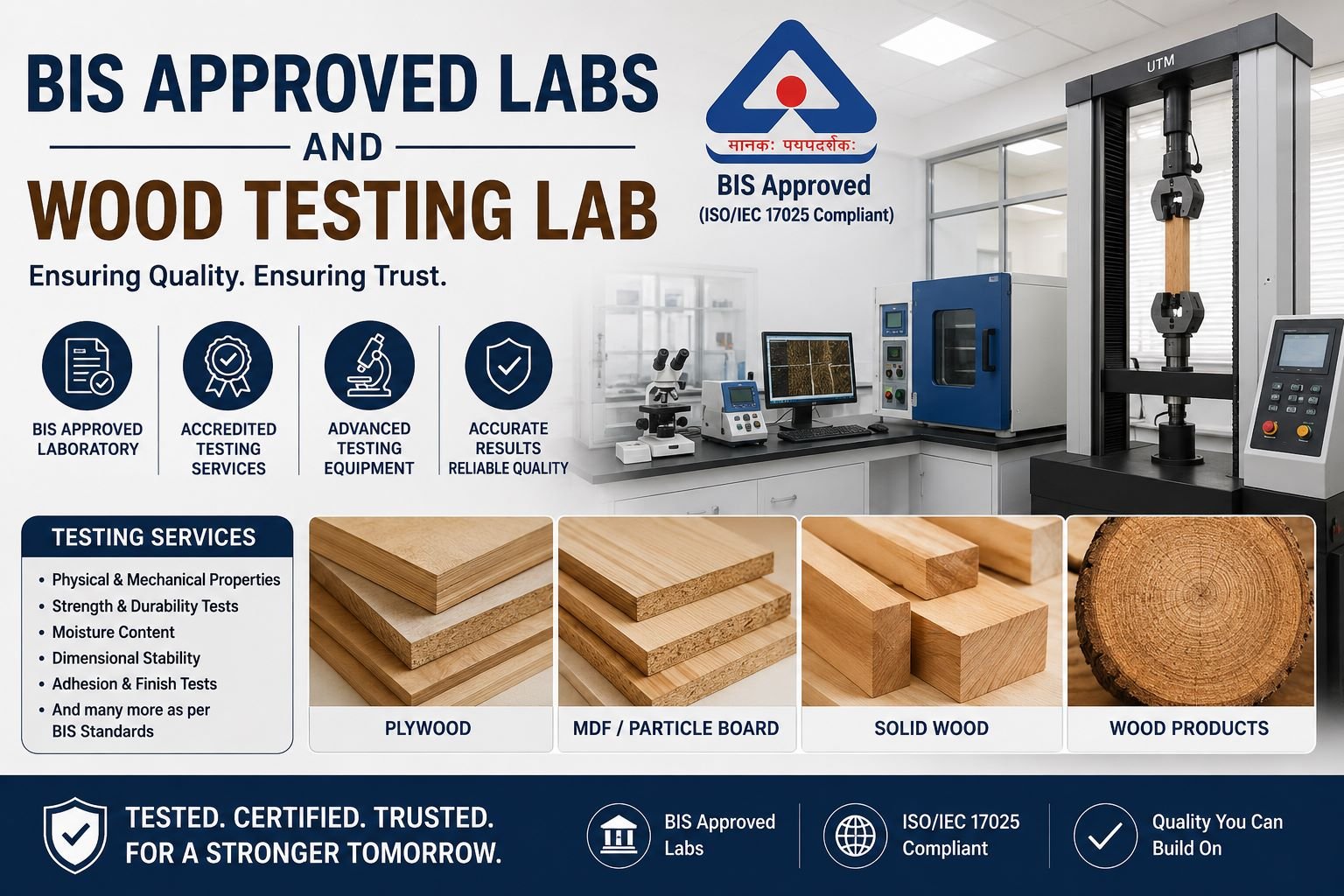
Product appearance alone cannot confirm strength, durability, moisture resistance, bonding quality, or compliance with applicable standards. This is where BIS approved Labs and a professional Wood Testing lab become valuable.
The Bureau of Indian Standards, India’s national standards body, operates conformity assessment systems supported by its own laboratories and laboratories recognised or empanelled for specified testing scopes. Businesses can use the BIS Laboratory Information Management System to identify laboratories recognised for particular Indian Standards.
For wood manufacturers and buyers, laboratory testing provides measurable evidence about material quality. It helps determine whether plywood, timber, boards, veneers, furniture components, and related products satisfy specified technical and performance requirements.
Understanding the Role of BIS Approved Labs
The term BIS approved Labs is commonly used for laboratories associated with testing under BIS conformity assessment activities. More precisely, BIS maintains its own laboratories as well as recognised and empanelled external testing facilities. Their approved testing scope can vary, so selecting a laboratory simply because it is BIS recognised is not enough.
The laboratory should have the required scope for the relevant Indian Standard and product category. BIS provides an online LIMS platform where users can search laboratories by Indian Standard number and check their available testing scope.
Testing through an appropriate laboratory may support:
- Product quality assessment
- BIS certification processes
- Regulatory conformity verification
- Manufacturer quality control
- Product development
- Supplier qualification
- Buyer inspection requirements
- Technical dispute resolution
The objective is to create reliable technical evidence rather than depending only on visual inspection or supplier declarations.
Why a Wood Testing Lab Is Important
Wood is a natural material, which means its physical properties can vary significantly. Species, moisture content, density, grain direction, manufacturing process, adhesives, storage conditions, and environmental exposure can all affect performance.
A competent Wood Testing lab evaluates these variables using controlled testing procedures.
For example, two plywood sheets may look almost identical but may perform differently under moisture, load, repeated use, or changing temperatures. Testing helps identify these differences before materials are used in furniture, buildings, packaging, interiors, or industrial applications.
The results can help manufacturers improve consistency while giving buyers greater confidence about the materials they purchase.
Products Commonly Evaluated by Wood Testing Laboratories
Testing requirements depend on the material and its intended application. A Wood Testing lab may evaluate products such as:
- Plywood
- Block boards
- Particle boards
- Fibreboards
- Flush doors
- Decorative plywood
- Marine plywood
- Structural plywood
- Timber
- Wood panels
- Veneers
- Laminated wood products
- Furniture components
- Wooden packaging materials
BIS maintains multiple Indian Standards covering plywood categories, test methods, technical requirements and related practices. Its plywood standards compendium explains that standards are intended to support consistent product quality and dependable performance.
Important Tests Conducted on Wood Products
Different materials require different test parameters. A specialised Wood Testing lab selects the applicable testing procedure according to the relevant standard, customer specification, or end-use requirement.
Common evaluations may include:
Moisture content testing: Measures the quantity of moisture present in the material. Excess moisture can influence dimensional stability, fungal growth and product performance.
Density testing: Evaluates mass in relation to volume and helps understand the physical characteristics of timber and engineered wood.
Water resistance testing: Determines how a product performs when exposed to water or moisture for specified conditions.
Bonding quality: Important for plywood and laminated products where adhesive performance influences durability.
Mechanical strength: Tests may assess the material’s ability to withstand bending, compression, tension or other loads depending on the product.
Dimensional stability: Evaluates whether the material changes excessively because of moisture or environmental conditions.
Testing requirements should always be selected according to the applicable product standard rather than applying the same test package to every wood product.
BIS Approved Labs vs General Wood Testing Labs
| Parameter | BIS Recognised Laboratory | General Wood Testing Laboratory |
| Main purpose | Testing within recognised BIS scope | Commercial or technical product evaluation |
| Applicable standards | Specific recognised Indian Standards | National, international or customer specifications |
| Certification support | May support applicable BIS conformity processes | Depends on laboratory status |
| Scope verification | Available through BIS LIMS | Must be verified directly |
| Typical users | Manufacturers seeking conformity assessment | Manufacturers, buyers, exporters and consultants |
A laboratory can be technically capable yet not be recognised by BIS for a particular Indian Standard. Therefore, companies seeking testing specifically for BIS conformity purposes should verify the laboratory’s current scope before submitting samples.
How to Select the Right Wood Testing Lab
Choosing the correct laboratory can prevent unnecessary retesting, additional expenses and certification delays.
Before selecting a Wood Testing lab, consider these points:
- Identify the exact product requiring testing.
- Determine the applicable Indian Standard or customer specification.
- Confirm whether BIS recognition is required.
- Verify that the laboratory’s current scope includes the relevant standard.
- Ask which tests and sample quantities are required.
- Confirm the expected report format.
- Review testing charges and turnaround arrangements.
- Confirm sample preparation and submission instructions.
BIS currently provides laboratory-wise and Indian Standard-wise testing facility information through its LIMS system, allowing manufacturers to verify relevant facilities before proceeding.
Benefits for Wood and Furniture Manufacturers
Using professional BIS approved Labs or an appropriate Wood Testing lab is not merely a certification formality. Testing can become an important component of manufacturing quality control.
It can help manufacturers identify inconsistent raw materials, weak bonding, excessive moisture, inadequate strength, processing problems, and variations between production batches.
Regular testing may also support:
- Better supplier selection
- More consistent manufacturing
- Reduced product rejection
- Improved technical documentation
- Easier customer qualification
- Better complaint investigation
- Improved product development
- Increased buyer confidence
For exporters and large institutional suppliers, verified test reports can also simplify technical discussions with procurement teams.
Testing Before BIS Certification
Where a product falls within an applicable BIS conformity assessment requirement, manufacturers need to understand the relevant standard, product manual, testing requirements and certification procedure.
Testing should not be arranged randomly.
First identify the applicable Indian Standard and then verify which laboratory has the necessary recognised testing scope. BIS confirms that its LIMS portal provides Indian Standard-wise information on BIS laboratories and recognised laboratories.
This approach reduces the risk of obtaining a report that cannot be used for the intended certification purpose.
Frequently Asked Questions About BIS Approved Labs and Wood Testing
1. What are BIS approved Labs?
The phrase generally refers to BIS laboratories or external laboratories recognised or empanelled by BIS for defined testing activities and standards.
2. What does a Wood Testing lab do?
It evaluates wood, plywood, boards and related materials for physical, mechanical, durability and other specified properties.
3. Can every BIS recognised laboratory test wood products?
No. Laboratory recognition is scope-specific. Always verify whether the relevant wood product and Indian Standard are included.
4. Where can I check BIS recognised laboratories?
The BIS Laboratory Information Management System provides current laboratory information and allows searches by laboratory and Indian Standard.
5. Why is plywood testing necessary?
It can verify characteristics such as bonding quality, strength, moisture behaviour and conformity with applicable specifications.
6. Is visual inspection sufficient for wood quality?
No. Appearance cannot reliably determine internal bonding, moisture content, mechanical performance or resistance characteristics.
7. How much sample is required for wood testing?
Sample requirements vary according to the product, applicable standard and tests requested.
8. How long does laboratory testing take?
Turnaround depends on the test method, conditioning requirements, sample quantity and laboratory workload.
9. Can testing improve manufacturing quality?
Yes. Test results can reveal production inconsistencies and help manufacturers improve raw materials, processing and quality-control procedures.
10. Should I verify laboratory scope before submitting samples?
Yes. Scope verification is especially important when the report is intended for a BIS conformity assessment process.