As plastic manufacturers, polymer processors, and industrial machinery companies focus on production efficiency, material quality, and equipment reliability, extrusion technology continues to play an important role in modern manufacturing.
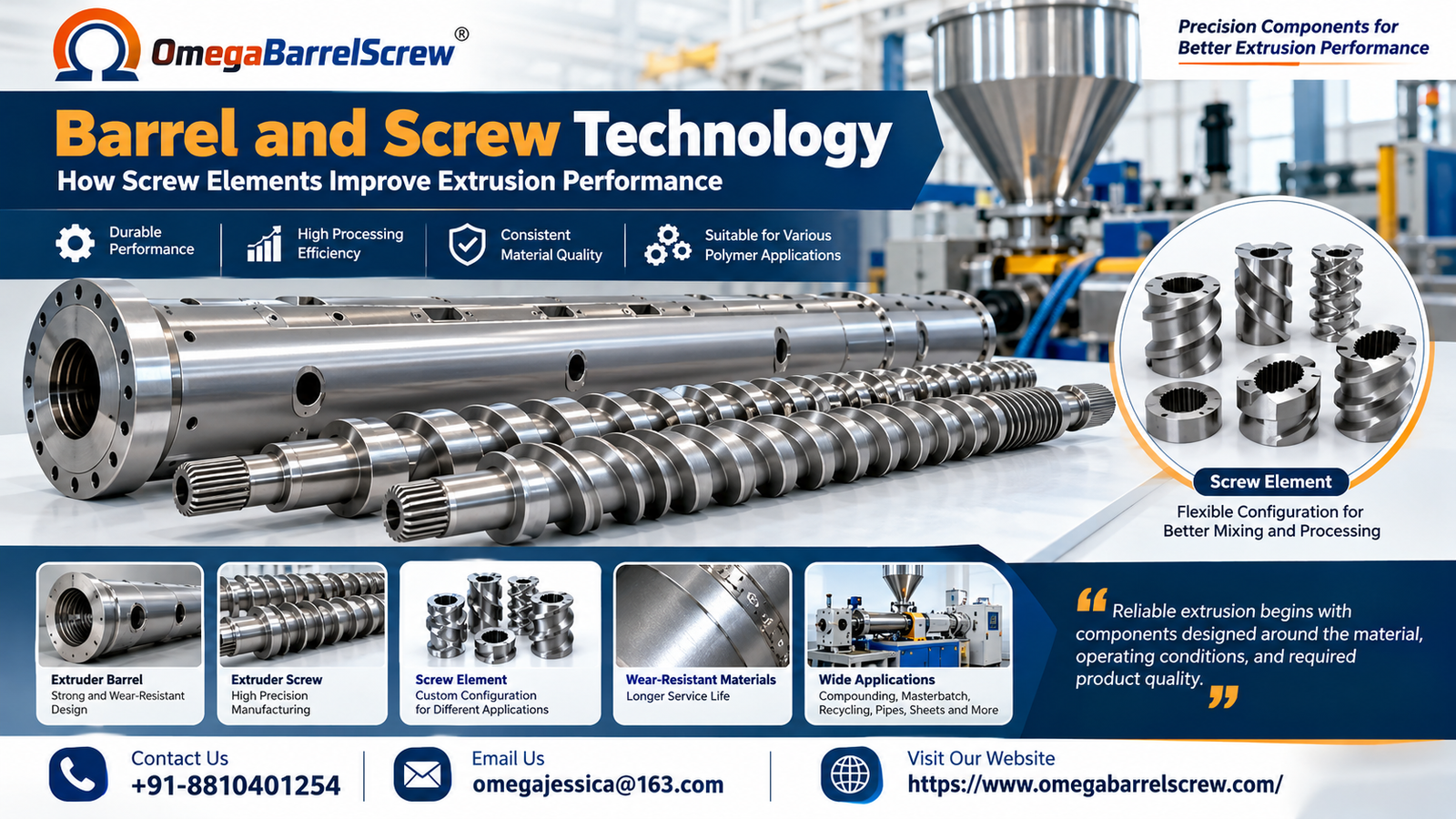
The barrel and screw assembly forms the core of an extrusion machine, helping transport, melt, compress, and process raw materials. Meanwhile, a screw element performs specific conveying, mixing, or kneading functions within suitable modular extrusion systems.
Both components influence processing consistency, material quality, energy consumption, and machinery performance.
Understanding their construction, working principles, materials, and maintenance requirements helps manufacturers select appropriate extrusion equipment components.
What Is a Barrel and Screw Assembly?
A barrel and screw assembly is a fundamental component of plastic extrusion machinery.
The barrel is a cylindrical housing containing one or more rotating screws. The screw moves material through the processing system while controlled heating and mechanical energy contribute to material transformation.
These assemblies are commonly used in polymer extrusion, plastic recycling, compounding, and manufacturing applications.
Key Features of Barrel and Screw Assemblies
- Material Conveying: Moves raw materials through the processing zones.
- Melting Support: Helps convert suitable solid polymers into processable melts.
- Pressure Development: Supports material flow toward the extrusion die.
- Temperature Control: Works with heating and cooling systems.
- Mixing Performance: Contributes to material homogenization.
- Wear Resistance: Suitable materials help withstand demanding processing conditions.
Understanding Screw Element Technology
A screw element is an individual processing component used in modular screw assemblies, particularly in twin-screw extruders.
These elements are mounted onto compatible screw shafts to create processing configurations for different materials.
Their geometry influences material transport, residence time, shear, mixing, and pressure development.
Common Types of Screw Elements
Conveying Elements: Transport materials through the barrel.
Kneading Elements: Support melting and intensive mixing.
Mixing Elements: Promote material distribution and homogenization.
Reverse Elements: Create additional flow resistance in suitable configurations.
Specialized Elements: Provide application-specific processing characteristics.
The arrangement of these components must be engineered according to the extruder and formulation requirements.
How Barrel and Screw Components Work Together
During extrusion, raw materials enter through a feeding system and move into the barrel.
Rotating screws transport the materials through different processing sections.
Heat transfer, mechanical shear, and controlled pressure contribute to melting and mixing.
The processed material then moves toward the die or another downstream processing stage.
In modular systems, each screw element contributes to specific processing functions.
Barrel and Screw vs. Screw Element: Key Differences
| Feature | Barrel and Screw | Screw Element |
| Primary function | Material processing assembly | Specific processing function |
| Construction | Barrel housing and rotating screw | Individual modular component |
| Main applications | Extrusion and polymer processing | Modular extrusion systems |
| Design focus | Overall processing performance | Conveying, mixing, or kneading |
| Maintenance | Wear and clearance inspection | Element wear and shaft compatibility |
| Selection factors | Machine dimensions and materials | Geometry and processing requirements |
Although closely related, these components serve different engineering purposes.
Materials Used in Extrusion Components
Extrusion machinery operates under demanding thermal and mechanical conditions.
Material selection directly influences component durability and processing reliability.
Alloy Steel
Suitable alloy steels provide mechanical strength for selected screw and barrel applications.
Nitrided Steel
Nitriding treatments can improve surface hardness and wear resistance.
Bimetallic Barrels
Certain barrel designs incorporate wear-resistant internal layers to improve performance in abrasive processing environments.
Wear-Resistant Alloys
Specialized alloys may be selected for applications involving fillers, additives, or corrosive materials.
The appropriate material depends on polymer chemistry, processing temperature, and anticipated wear conditions.
Industrial Applications of Screw and Barrel Technology
Extrusion components support numerous manufacturing processes.
Plastic Compounding
Modular screws help combine polymers with pigments, fillers, and additives.
Masterbatch Manufacturing
Specialized screw configurations support pigment and additive dispersion.
Plastic Recycling
Suitable extrusion equipment processes selected recycled polymer materials.
Pipe and Profile Manufacturing
Single-screw systems are frequently used to produce continuous plastic products.
Specialty Polymer Processing
Advanced equipment can process formulations requiring controlled mixing and temperature conditions.
Each application requires compatible machine components and operating parameters.
Importance of Screw Geometry in Extrusion
Screw geometry influences how materials move and transform inside the extruder.
Important design factors include screw diameter, flight geometry, pitch, channel depth, and processing-element arrangement.
A screw element with intensive mixing characteristics may improve dispersion in suitable applications but can also increase shear heating.
Therefore, greater mixing intensity does not automatically mean better processing.
Manufacturers should balance product requirements, throughput, temperature control, and material sensitivity.
Quality Testing and Manufacturing Standards
Professional extrusion component manufacturing requires accurate engineering and inspection.
Important quality evaluations may include:
- Dimensional Inspection: Verifies component dimensions.
- Material Testing: Confirms appropriate material characteristics.
- Hardness Testing: Evaluates relevant surface or material hardness.
- Surface Inspection: Identifies visible manufacturing defects.
- Fit Verification: Confirms compatibility with shafts and barrels.
- Wear Evaluation: Assesses component condition during maintenance.
Proper documentation supports technical purchasing decisions and replacement planning.
Maintenance of Barrel and Screw Components
Regular maintenance contributes to machinery reliability.
Operators should monitor processing temperature, pressure, vibration, and unusual changes in product quality.
The barrel and screw assembly should be inspected for excessive wear, surface damage, and changes in operating clearances.
Modular elements also require inspection for damage and compatibility with adjoining components.
Maintenance activities must follow equipment manufacturer instructions and appropriate machinery isolation procedures.
Choosing a Reliable Extrusion Component Supplier
Industrial buyers should evaluate engineering capabilities, manufacturing accuracy, available materials, and technical support.
Important purchasing considerations include:
- Machine model and component dimensions
- Required screw geometry
- Material compatibility
- Surface treatment requirements
- Manufacturing tolerances
- Quality inspection procedures
- Replacement component compatibility
- Delivery and technical assistance
Sharing accurate machinery specifications can help suppliers recommend suitable solutions.
Frequently Asked Questions (FAQs)
1. What is a barrel and screw assembly?
It is an extrusion machinery assembly used to convey, melt, mix, and process suitable raw materials.
2. What is a screw element?
A screw element is an individual modular component that performs specific processing functions in compatible extruders.
3. Where are screw elements commonly used?
They are widely used in modular twin-screw extrusion systems.
4. Why is screw geometry important?
It influences material conveying, mixing, melting, shear, and pressure development.
5. What materials are used for extrusion screws?
Suitable alloy steels, nitrided steels, and specialized wear-resistant materials are commonly used.
6. Can screw elements be customized?
Yes. Manufacturers may offer different configurations based on equipment specifications and processing requirements.
7. What causes barrel and screw wear?
Abrasive fillers, mechanical contact, corrosive ingredients, and operating conditions can contribute to wear.
8. Can damaged screw elements be replaced?
Yes, provided compatible replacement components are available and installed correctly.
9. How can extrusion efficiency be improved?
Appropriate screw design, temperature control, material preparation, and regular maintenance can support efficient operation.
10. How should manufacturers choose an extrusion component supplier?
Evaluate technical expertise, manufacturing precision, material quality, inspection procedures, and product compatibility.
Media Contact
Department: Extrusion Machinery Components and Business Communications
Email: omegajessica@163.com; 965425705@qq.com
Contact: +86-15021464410
Official Website: https://www.omegabarrelscrew.com/