From factory machinery and power systems to transportation equipment and automated production lines, uncontrolled vibration can influence mechanical performance and maintenance requirements.
Custom Molded Rubber offers engineering teams an opportunity to develop specialised components designed around specific equipment dimensions, load conditions, and environmental requirements.
Unlike standard rubber products, custom-molded parts can be developed with selected geometries, material compounds, and mechanical characteristics.
These components may serve as vibration isolators, protective bumpers, mounting pads, flexible supports, or impact-absorbing elements.
For machinery manufacturers and industrial engineers, understanding the relationship between rubber material properties and mechanical performance can help support more dependable equipment designs.
Why Vibration Control Matters in Industrial Equipment
Industrial machinery frequently contains moving components that generate vibration during operation.
Motors, compressors, pumps, and mechanical drive systems can transfer vibration through their mounting arrangements and supporting structures.
Excessive vibration may contribute to noise, component fatigue, or mechanical discomfort in surrounding work areas.
Suitable isolation components can help manage vibration transmission under defined operating conditions.
However, rubber components must be correctly selected and engineered to deliver the intended performance.
What Is Custom Molded Rubber?
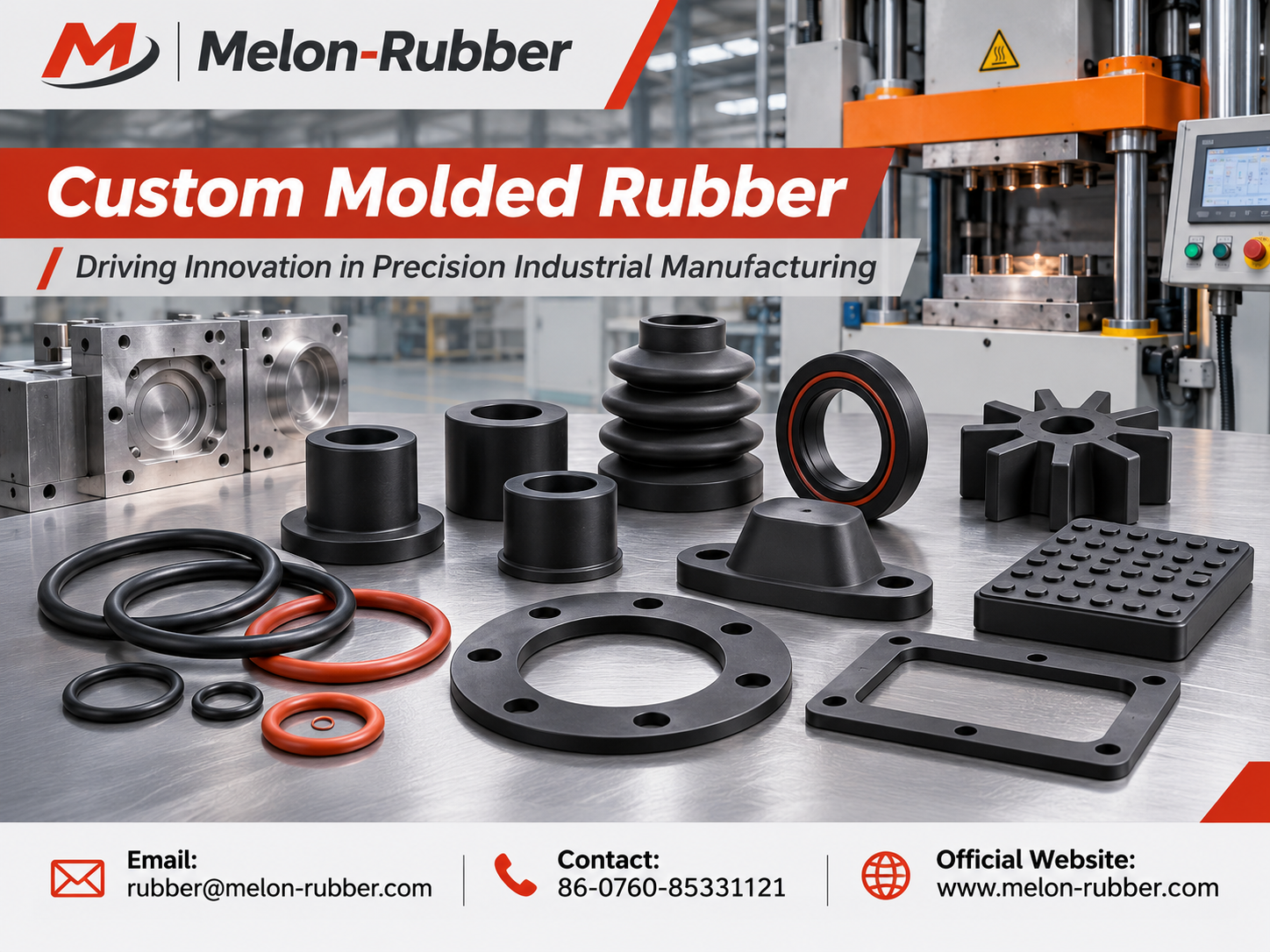
Custom Molded Rubber refers to rubber components manufactured using molds designed for particular shapes, dimensions, and functional requirements.
Manufacturers may use compression molding, transfer molding, or injection molding, depending on the material and component design.
During production, rubber compounds are shaped and cured under controlled conditions.
Finished products can feature specialised profiles, mounting arrangements, flexible surfaces, and integrated design details.
Applications may include industrial mounts, protective guards, bushings, bumpers, and vibration-control components.
The selected material and manufacturing process should reflect the component’s intended mechanical and environmental requirements.
How Rubber Helps Manage Vibration
Rubber materials exhibit elastic and energy-dissipating behaviour.
When correctly engineered, a rubber component can deform under an applied load and help reduce the transmission of certain vibrations.
However, isolation performance depends on several factors, including stiffness, mass, loading direction, excitation frequency, and damping characteristics.
A softer material does not automatically provide better performance.
Excessive flexibility may allow unwanted movement, while excessive stiffness can transmit more vibration than intended.
Engineers should therefore consider the complete mechanical system before selecting a rubber component.
Common Applications in Industrial Machinery
Custom rubber components can support various equipment requirements.
| Industrial Application | Rubber Component | Intended Function |
| Electric Motors | Vibration Mounts | Manage mechanical vibration |
| Compressors | Isolation Pads | Reduce selected vibration transmission |
| Industrial Pumps | Flexible Supports | Support suitable mounting arrangements |
| Manufacturing Equipment | Rubber Bumpers | Cushion contact and impacts |
| Transport Equipment | Rubber Bushings | Accommodate controlled movement |
| Control Cabinets | Protective Pads | Reduce contact and mechanical stress |
Actual performance depends on material selection, component geometry, and installation conditions.
Choosing the Right Rubber Material
Different elastomers provide different mechanical and environmental characteristics.
Natural rubber may be suitable for certain dynamic applications, while EPDM offers useful resistance to weathering and selected environmental conditions.
Nitrile rubber is often considered for applications involving compatible oils.
Silicone rubber may be selected for particular temperature requirements.
However, material suitability depends on the actual compound formulation.
Manufacturers should evaluate relevant technical information before approving a material for production.
Why Component Geometry Influences Performance
The shape of a molded rubber component can significantly influence its mechanical behaviour.
Thickness, contact area, mounting holes, and compression surfaces affect how loads are distributed.
For example, a component designed primarily for compression may behave differently when subjected to shear forces.
Engineers must also consider installation space and allowable movement.
Incorrect geometry can lead to excessive deformation or inadequate mechanical support.
Prototype evaluation can help determine whether the design satisfies its intended functional requirements.
Understanding Rubber Hardness and Flexibility
Rubber hardness is commonly measured using an appropriate Shore hardness scale.
This measurement helps describe a material’s resistance to indentation.
However, hardness alone does not establish vibration isolation capability.
Dynamic stiffness, damping behaviour, load conditions, and geometry also influence performance.
Two rubber components with similar hardness values may behave differently because of their designs and material formulations.
For critical applications, mechanical testing should reflect the actual operating conditions.
Why Precision Molding Matters
Custom rubber manufacturing requires accurate tooling and controlled production procedures.
Mold design influences finished dimensions, material distribution, surface appearance, and component consistency.
Important considerations include cavity geometry, curing conditions, dimensional tolerances, and material flow.
Poorly controlled molding may create defects such as incomplete filling, excess flash, or inconsistent dimensions.
Manufacturers should establish suitable inspection procedures to identify nonconforming products.
Precision manufacturing supports repeatability but must be combined with appropriate engineering design.
Improving Equipment Protection Through Rubber Components
Rubber parts can provide mechanical protection beyond vibration management.
Protective bumpers may help cushion contact between moving components.
Rubber pads can reduce direct contact between selected surfaces.
Flexible bushings can accommodate controlled movement in suitable mechanical assemblies.
However, these components should not be used as substitutes for required structural supports or safety devices.
The design must account for applicable loads and expected operating conditions.
Effective equipment protection requires evaluating the complete assembly.
Testing Custom Rubber Components
Quality verification is essential when rubber parts perform important mechanical functions.
Depending on the application, testing may include:
- Dimensional Inspection: Verifies component measurements.
- Hardness Testing: Evaluates material indentation resistance.
- Compression Testing: Examines behaviour under applied loads.
- Dynamic Testing: Assesses selected vibration-related characteristics.
- Ageing Evaluation: Investigates changes under defined conditions.
- Visual Inspection: Identifies relevant manufacturing defects.
Testing procedures should be selected according to actual engineering requirements.
Choosing a Custom Rubber Manufacturing Partner
Industrial buyers should evaluate manufacturers based on their technical understanding and production capabilities.
Important considerations include material formulation knowledge, mold design capabilities, prototype support, quality controls, and engineering communication.
Customers should provide clear component drawings, operating conditions, and performance expectations.
A suitable manufacturing partner should explain both the possibilities and limitations of the proposed component.
Transparent technical discussions can help reduce costly design misunderstandings.
Frequently Asked Questions (FAQs)
1. What is Custom Molded Rubber?
It refers to rubber products manufactured using specially designed molds to meet particular dimensions, material specifications, and functional requirements.
2. Where are custom rubber components commonly used?
Applications include industrial machinery, automotive equipment, electrical systems, transportation products, and mechanical protection assemblies.
3. Can molded rubber reduce industrial vibration?
Yes. Properly designed rubber isolators can help reduce certain vibration transmission under suitable loading and operating conditions.
4. Which rubber material is best for industrial components?
The appropriate material depends on mechanical loads, temperature, chemical exposure, environmental conditions, and product design.
5. How can manufacturers ensure consistent rubber component quality?
They should use appropriate material specifications, precision tooling, controlled manufacturing processes, and application-specific inspection procedures.
Media Contact
Department: Custom Rubber Molding and Industrial Manufacturing Enquiries
Phone: 86-0760-85331121
Email: rubber@melon-rubber.com
Official Website: https://www.melon-rubber.com/