Selecting a stainless steel pipe involves more than choosing the correct diameter and material grade. Wall thickness, operating pressure, temperature, corrosion exposure, joining method and service conditions all influence whether a pipe will perform reliably over its intended working life.
Stainless Steel Pipe Schedule 40 is widely specified for industrial piping, water systems, chemical processing, food and beverage facilities, fabrication projects and other applications where a practical balance between wall thickness, strength and installation requirements is needed.
For applications that do not require the same wall thickness, Schedule 10 Stainless Steel Pipe may provide a lighter alternative. Understanding how these schedules differ helps engineers, contractors, fabricators and procurement teams avoid both under-specification and unnecessary material cost.
What Is Stainless Steel Pipe Schedule 40?
Stainless Steel Pipe Schedule 40 is a pipe manufactured to a defined wall-thickness schedule, with the actual wall thickness determined by its nominal pipe size.
The word “Schedule” does not identify the stainless steel grade. Instead, it relates to pipe wall thickness according to the applicable dimensional standard. For example, stainless steel grades such as 304/304L and 316/316L may be supplied in different schedules depending on the required application.
An important purchasing point is that Schedule 40 does not mean the wall has the same thickness for every pipe diameter. Wall dimensions change with nominal pipe size.
This distinction matters when calculating:
· Internal flow area
· Pipe weight
· Material requirements
· Welding parameters
· Pressure capability
· Fitting compatibility
· Structural loading and support requirements
Buyers should therefore specify the nominal pipe size, stainless steel grade, schedule, manufacturing type and applicable standard rather than requesting “Schedule 40 pipe” alone.
Understanding Stainless Steel Pipe Schedules
A pipe schedule is a standardised way of identifying wall thickness. Common schedules encountered in stainless steel piping include Schedule 5S, 10S, 40S and 80S, depending on the relevant standard and application.
Higher schedule designations generally correspond to greater wall thickness for a given nominal pipe size, but engineers should always consult the applicable dimensional standard rather than relying on the schedule number alone.
For stainless steel systems, the suffix “S” is also important. Stainless pipe dimensions are commonly specified using stainless-specific schedule designations such as 10S and 40S.
Is Schedule 40 the Same as 40S?
Not necessarily in every nominal size.
Schedule 40 and Schedule 40S can share dimensions across some size ranges, but they should not automatically be treated as interchangeable. The required specification and dimensional standard should be checked before ordering or substituting material.
Internal-link opportunity: Use anchor text such as stainless steel pipe dimensions to direct visitors to a detailed dimensional reference page.
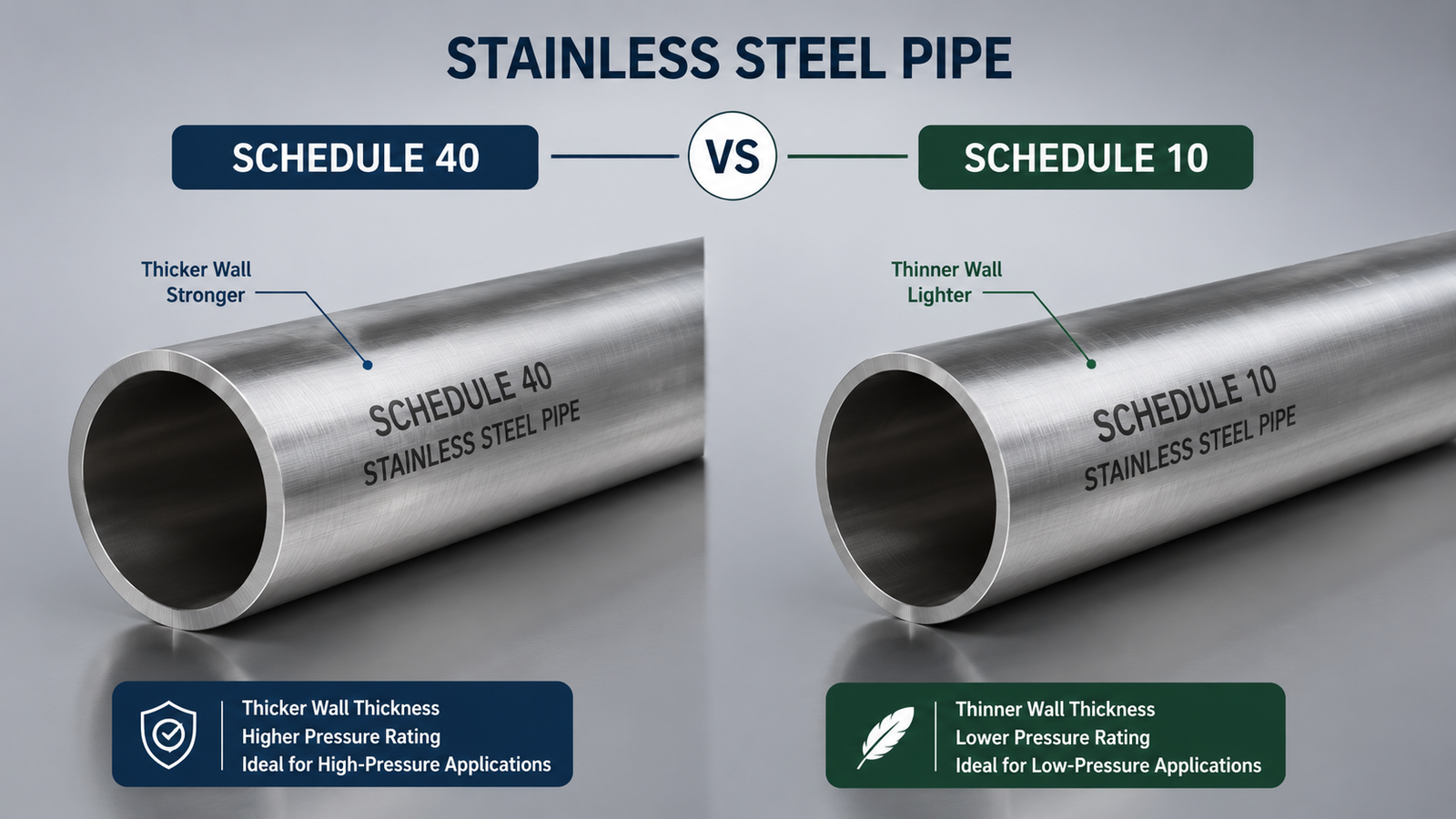
Stainless Steel Pipe Schedule 40 vs Schedule 10 Stainless Steel Pipe
One of the most common purchasing decisions is whether a project needs Schedule 40 or a thinner-wall option.
| Factor | Stainless Steel Pipe Schedule 40 | Schedule 10 Stainless Steel Pipe |
| Wall | Generally thicker | Generally thinner |
| Weight | Higher | Lower |
| Material usage | Greater | Lower |
| Handling | Heavier | Easier where reduced weight is beneficial |
| Internal bore | Smaller for the same OD when wall is thicker | Larger for the same OD |
| Typical selection | More demanding piping or mechanical requirements | Lower-wall-thickness applications |
| Welding | May require more welding input depending on size | Thin-wall welding needs careful heat control |
| Cost consideration | Greater material content can increase cost | Lower material content may reduce material cost |
The correct choice cannot be made from cost alone. Design pressure, temperature, corrosion allowance, mechanical loads and the applicable piping code must be considered.
When Should You Choose Schedule 40?
A Stainless Steel Pipe Schedule 40 may be appropriate where the piping design requires a more substantial wall than lighter schedules.
Typical considerations include:
1. Operating Pressure
Pipe wall thickness is one factor affecting pressure capability. However, a Schedule 40 designation by itself should never be treated as a pressure rating.
Actual allowable pressure depends on variables such as material grade, outside diameter, wall thickness, temperature, manufacturing specification, joint design and applicable engineering code.
2. Mechanical Loads
Industrial piping can experience loads unrelated to internal pressure. Pipe supports, vibration, connected equipment, installation conditions and external forces can influence the required wall thickness.
3. Fabrication Requirements
Schedule 40 pipe is frequently used in fabricated piping systems because its wall profile can suit a broad range of welding and fabrication requirements.
Qualified welding procedures should still be followed, particularly in critical process systems.
4. Long-Term Service Conditions
Where the system may experience demanding operating conditions, engineers can assess whether the additional wall thickness provides an appropriate design margin.
This should form part of the engineering calculation rather than being assumed simply because the pipe is labelled Schedule 40.
Where Is Schedule 10 Stainless Steel Pipe Used?
Schedule 10 Stainless Steel Pipe has a thinner wall than Schedule 40 for many comparable nominal sizes and can be useful where the design does not require a heavier wall.
Potential applications may include:
· Process piping
· Water distribution
· Food and beverage processing
· Pharmaceutical installations
· Low-pressure fluid systems
· Architectural fabrication
· General stainless steel fabrication
· Selected chemical processing lines
Its reduced weight can make handling and installation easier, particularly on larger piping projects.
However, choosing a thinner schedule solely to reduce purchasing costs can create problems if the design requires greater mechanical strength, corrosion allowance or pressure capability.
Internal-link opportunity: Link Schedule 10 stainless steel pipe specifications to a dedicated product or technical data page.
304 vs 316 Stainless Steel Schedule 40 Pipe
Pipe schedule and stainless steel grade describe different characteristics.
The schedule concerns dimensional wall thickness, while the grade determines material composition and associated properties.
304/304L Stainless Steel
304 and 304L are commonly specified austenitic stainless steels used across general industrial, food processing, fabrication and water-handling applications.
The low-carbon 304L grade is particularly relevant to welded applications where resistance to sensitisation associated with welding is important.
316/316L Stainless Steel
316 and 316L contain molybdenum, which generally provides improved resistance to pitting and crevice corrosion in chloride-containing environments compared with 304.
This makes 316/316L a common consideration for more corrosive processing environments and certain coastal or marine-exposed applications.
Material selection should nevertheless be based on the actual chemical environment, chloride concentration, temperature and operating conditions.
Internal-link opportunity: Add a link using 304 vs 316 stainless steel pipe for buyers who need help comparing material grades.
Seamless vs Welded Schedule 40 Stainless Steel Pipe
Another important purchasing decision is whether the project requires seamless or welded construction.
Seamless Stainless Steel Pipe
Seamless pipe is manufactured without a longitudinal welded seam. It is used in many process and industrial applications where the specification or engineering requirements call for seamless construction.
Welded Stainless Steel Pipe
Welded pipe is manufactured from stainless steel strip or plate that is formed and longitudinally welded. Modern welded stainless pipe is used extensively across industrial and commercial piping applications.
Neither construction method should be selected simply on the assumption that one is universally “better”. Project standards, pressure and temperature requirements, dimensions, inspection requirements, availability and cost should guide the decision.
How to Specify Stainless Steel Pipe Correctly
A technically complete enquiry makes it easier for a supplier to quote accurately and helps prevent expensive ordering mistakes.
Instead of requesting:
“Need Schedule 40 stainless pipe.”
A better enquiry would include:
“Stainless steel pipe, 316L, required nominal size, Schedule 40S, seamless or welded as specified, required standard, quantity, lengths, finish and certification requirements.”
For procurement, consider providing:
1. Nominal Pipe Size (NPS) or DN
2. Stainless steel grade
3. Required schedule
4. Seamless or welded construction
5. Applicable ASTM, ASME or other project standard
6. Required pipe length
7. Quantity
8. Surface finish where relevant
9. Testing requirements
10. Material certification requirements
11. Delivery destination
This level of detail significantly reduces ambiguity during quotation and procurement.
What Standards Should Buyers Check?
Stainless steel piping can be supplied under several standards depending on its intended service.
For example, ASTM A312 is commonly associated with seamless, welded and heavily cold-worked austenitic stainless steel pipe intended for high-temperature and general corrosive service.
Dimensional requirements may reference relevant ASME standards such as ASME B36.19M for stainless steel pipe.
However, standards should not be added to a purchase order merely because they are commonly used. The project engineer, piping specification or approved material standard should define what is required.
For regulated or critical applications, buyers should confirm:
· Material specification
· Dimensional standard
· Chemical composition requirements
· Mechanical properties
· Testing requirements
· Heat treatment condition
· Traceability
· Material Test Certificates (MTCs)
· Inspection requirements
Internal-link opportunity: Create a technical resource around stainless steel pipe standards and specifications.
How to Choose Between Schedule 10 and Schedule 40
The decision becomes easier when the operating requirements are considered systematically.
Choose based on engineering requirements first
Determine the design pressure and temperature, process fluid, material grade, corrosion conditions and external loads.
Calculate the required wall thickness
For engineered piping systems, wall thickness should be determined using the applicable design code rather than choosing a schedule by habit.
Consider corrosion and environment
A thicker wall is not automatically a substitute for selecting the correct alloy. If corrosion is the primary concern, moving from 304 to 316 or another suitable alloy may be more relevant than simply increasing wall thickness.
Evaluate fabrication and installation
Consider welding procedures, supports, fittings, valves, total installed weight and site accessibility.
Compare total project cost
The cheapest pipe per metre is not always the lowest-cost solution. Installation, fabrication, maintenance, service life and replacement risk can have a greater impact on total project expenditure.
Common Mistakes When Buying Stainless Steel Pipe
One frequent mistake is confusing nominal pipe size with actual outside diameter. NPS is a nominal designation and should not automatically be interpreted as the pipe’s measured OD.
Another is assuming that all Schedule 40 stainless steel pipes have identical wall thickness. The wall varies according to nominal size.
Buyers may also focus heavily on the schedule while overlooking material grade. A thicker 304 pipe does not automatically provide the corrosion performance required in an environment where 316L or another alloy is more suitable.
Finally, purchasing without confirming standards or certification can create problems when material traceability is required during inspection or project handover.
What Should You Ask a Stainless Steel Pipe Supplier?
Before placing an order, confirm exactly what will be supplied. Useful questions include:
· Is the requested grade available?
· Is the material Schedule 40, 40S, 10 or 10S as specified?
· What manufacturing standard applies?
· Is the pipe seamless or welded?
· Can material certification be provided?
· What lengths are available?
· Are matching elbows, tees, reducers and flanges available?
· What are the current lead times?
· Can the supplier provide dimensional and weight information?
· Are cutting or fabrication services available?
A technically knowledgeable supplier should be able to clarify specifications rather than simply quote a price against an incomplete description.
Frequently Asked Questions
What does Schedule 40 mean on stainless steel pipe?
Schedule 40 identifies a standard pipe wall-thickness series. The actual wall thickness depends on the nominal pipe size and applicable dimensional standard.
Is Stainless Steel Pipe Schedule 40 suitable for high pressure?
It can be used in many pressure applications, but Schedule 40 itself is not a pressure rating. Allowable pressure must be calculated using the pipe material, dimensions, temperature and relevant design code.
Is Schedule 10 Stainless Steel Pipe thinner than Schedule 40?
Generally, yes. For comparable nominal sizes, Schedule 10/10S typically has a thinner wall and lower weight than Schedule 40/40S.
Which is better, Schedule 10 or Schedule 40?
Neither is universally better. The correct schedule is the one that satisfies the project’s pressure, temperature, mechanical, corrosion and code requirements.
Does pipe schedule affect outside diameter?
For a given NPS, changing the schedule generally changes the wall thickness and therefore the internal diameter, while the specified outside diameter remains associated with that nominal pipe size.
Is Schedule 40 available in 304 and 316 stainless steel?
Yes, commonly specified stainless steel grades such as 304/304L and 316/316L can be supplied in Schedule 40/40S configurations, subject to size, standard and supplier availability.
Can Schedule 10 replace Schedule 40?
Only when engineering calculations and the applicable project specification permit the substitution. A thinner wall should not be substituted solely to reduce cost or weight.
Is 316 Schedule 40 better than 304 Schedule 40?
316 generally offers better resistance to certain chloride-related corrosion conditions, while 304 can be suitable for many general-purpose environments. Application conditions determine the appropriate grade.
What information should I provide when requesting a quotation?
Provide pipe size, grade, schedule, standard, seamless or welded construction, quantity, required length, certification requirements and delivery location.
How do I find a Stainless Steel Pipe Schedule 40 supplier near me?
Look for a supplier that can provide the required grade, dimensions, standards and certification—not simply local stock. For project procurement, also compare availability, delivery time and technical support.