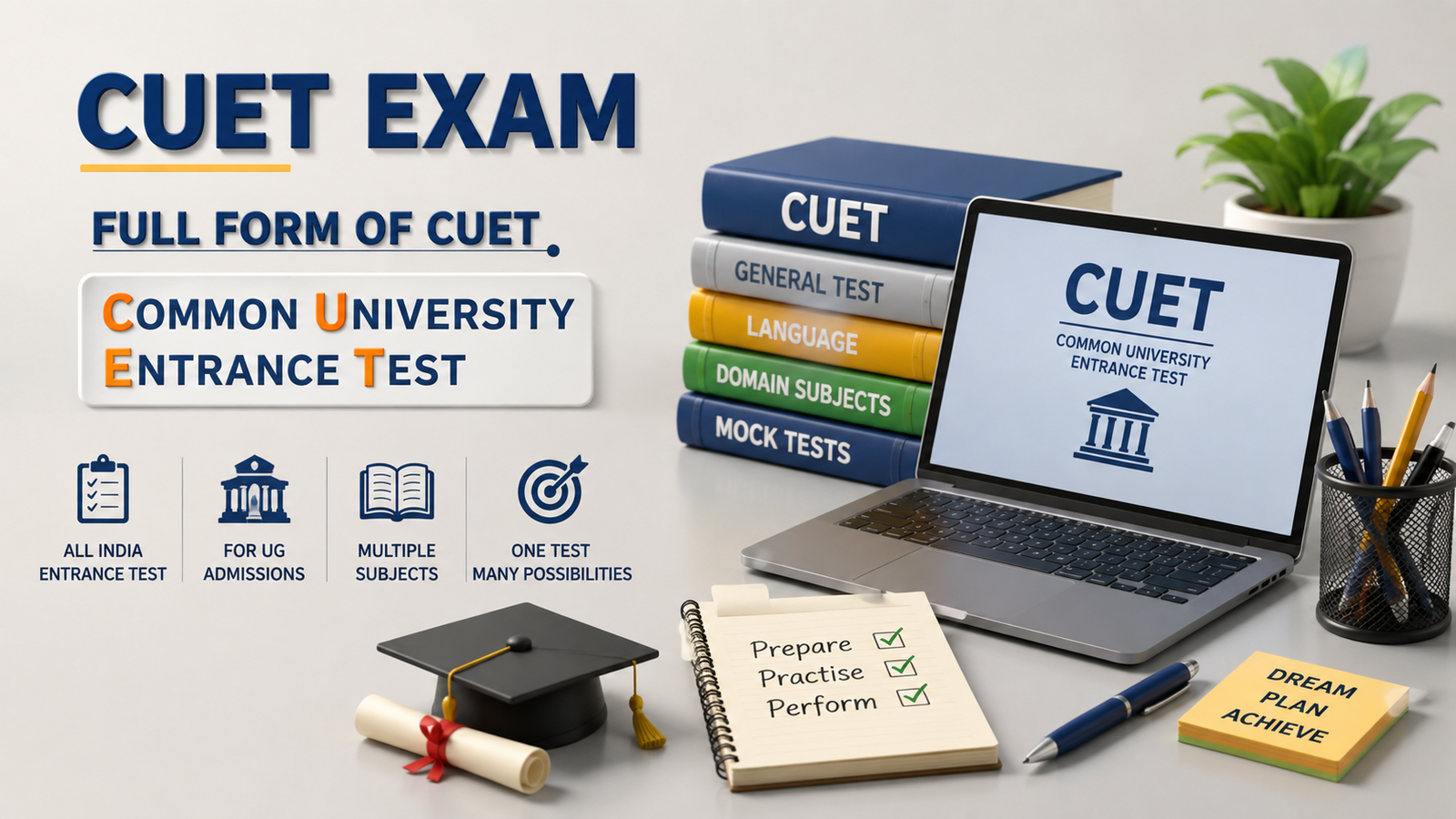
The CUET exam has become an important entrance route for students seeking admission to undergraduate programmes at participating universities across India. Instead of relying only on Class 12 board marks, CUET provides students with a common entrance examination through which participating institutions can evaluate applicants.
If you are preparing after Class 12 and are unsure about eligibility, subjects, application procedures or preparation, understanding the examination structure before starting your study plan can save considerable time.
This guide explains the full form of CUET, how the examination works, who can apply, subject selection, preparation strategies and important factors students should consider while planning university admissions.
What Is the Full Form of CUET?
The full form of CUET is Common University Entrance Test.
CUET is an entrance examination used for admission to undergraduate and, through a separate postgraduate examination, postgraduate programmes offered by participating universities and institutions in India.
The examination is conducted by the National Testing Agency (NTA). For undergraduate applicants, it is commonly referred to as CUET (UG).
Students should remember an important distinction:
· CUET (UG) is intended for undergraduate admissions.
· CUET (PG) is intended for postgraduate admissions.
If you have completed or are appearing for Class 12 and want admission to an undergraduate programme, CUET (UG) is the relevant examination.
What Is the CUET Exam?
The CUET exam is a common entrance test designed to provide participating universities with a standardised method of assessing applicants.
A student may use CUET scores while applying to eligible courses at multiple participating universities, subject to each institution’s admission policies.
However, appearing for CUET does not automatically make a candidate eligible for every university or programme.
Individual universities may specify their own requirements concerning:
· Class 12 subjects
· Minimum qualifying marks
· CUET subject combinations
· Language requirements
· Programme-specific eligibility
· Category and reservation conditions
· Counselling or admission procedures
Therefore, students should check both the CUET information bulletin and the admission requirements published by their preferred universities.
Who Conducts the CUET Exam?
The National Testing Agency (NTA) conducts CUET.
NTA is responsible for important examination-related processes such as applications, examination administration, admit cards, answer keys and scorecards. Universities subsequently use CUET results according to their respective admission criteria.
Because examination rules can change between admission cycles, candidates should rely on the latest official notification rather than assuming that previous-year rules will remain unchanged.
Suggested internal link: Latest CUET Exam Updates
Why Is the CUET Exam Important for Students?
CUET can simplify the entrance process for students interested in several participating universities.
Rather than preparing independently for numerous university-specific entrance examinations, candidates can focus on a common examination while still considering multiple institutions and courses.
Key Benefits of CUET
CUET offers several practical advantages:
1. Common assessment platform: Candidates are evaluated through a standardised entrance examination.
2. Access to participating universities: One CUET score can potentially be relevant to multiple institutions and programmes.
3. Course-focused preparation: Students can prepare according to the subjects required for their preferred programmes.
4. Broader university choices: Candidates can explore participating central, state, deemed and private universities, depending on the current admission cycle.
5. Reduced dependence on board marks alone: Admission decisions can incorporate CUET performance where universities use the examination for selection.
The actual value of CUET depends on the student’s target course and universities, so programme research should come before subject selection.
Who Is Eligible for the CUET Exam?
For CUET (UG), candidates generally need to have passed or be appearing in the Class 12 or equivalent examination, subject to the rules applicable to the relevant admission year.
However, CUET eligibility and university admission eligibility are not necessarily identical.
For example, a candidate may be permitted to appear for CUET but still need particular Class 12 subjects or a specific CUET subject combination to qualify for admission to a chosen degree.
What Should Students Check Before Applying?
Before completing the application, verify:
· Your Class 12 qualification
· Required subjects for your intended degree
· University-specific eligibility
· Required CUET test papers
· Programme-specific conditions
· Current application deadlines
· Applicable reservation/category rules
Never select CUET subjects simply because they appear easier. Choose them according to the admission requirements of your target programmes and universities.
Suggested internal link: CUET Eligibility Criteria
How Does the CUET Exam Work?
The CUET process typically involves several stages, beginning with course research and ending with university-level admission.
Step 1: Identify Your Preferred Course
First decide what you want to study, such as:
· BA
· BCom
· BSc
· BBA or related management programmes
· Language programmes
· Humanities and social sciences
· Other participating undergraduate programmes
Step 2: Shortlist Universities
Check which universities offer your chosen programme and whether they use CUET scores for that admission cycle.
Step 3: Check Required CUET Subjects
This is one of the most important steps.
Suppose Student A wants to apply for one course at three universities. University X may require one combination of CUET papers, while University Y may have different programme eligibility requirements.
The student must choose test papers that preserve eligibility for the universities and programmes they actually want.
Step 4: Complete the Application
Candidates submit their application according to the current NTA instructions and provide the required information.
Step 5: Prepare and Take the Examination
Preparation should focus on the official syllabus, applicable test structure, subject knowledge, question practice and time management.
Step 6: Check Results and University Admission Procedures
After CUET results are released, candidates must follow the admission or counselling procedures specified by their selected universities.
A CUET score by itself is not an admission offer.
What Subjects Are Available in CUET?
CUET may include language papers, domain-specific subjects and other papers according to the structure notified for that examination year.
Domain subjects can cover areas studied at senior-secondary level, depending on the current subject list.
The most important question is therefore not simply “Which CUET subjects are available?” but “Which CUET subjects do I need for my target course?”
How Should You Choose CUET Subjects?
Use this order:
Course → University → Eligibility → Required CUET papers → Application
Do not reverse it by choosing papers first and looking for compatible universities afterwards.
Create a simple eligibility sheet containing your preferred courses, universities and required test papers before submitting the application.
Suggested internal link: How to Choose Subjects for CUET
What Is the CUET Exam Pattern?
The exact CUET exam pattern can change by examination cycle, so students should always verify the latest NTA information bulletin.
Depending on the current rules, the examination framework may involve language, domain and/or aptitude-related papers, with objective questions and a defined marking scheme.
When checking the latest pattern, pay particular attention to:
| Factor | What to Check |
| Examination mode | Current mode announced by NTA |
| Question type | Format used for your selected papers |
| Subjects | Papers permitted and required |
| Duration | Time available for each test |
| Marking | Marks awarded and deducted |
| Syllabus | Official syllabus for each selected paper |
Avoid preparing solely from an old YouTube video, blog post or previous-year pattern. Always compare third-party guidance with the current official information.
Is the CUET Exam Difficult?
The CUET exam is manageable with structured preparation, but its difficulty varies according to the candidate’s subjects, academic foundation, target programme and desired university.
For a competitive programme, simply qualifying may not be enough. Students may need a strong score relative to other applicants and the admission criteria of their preferred institution.
Three areas often determine performance:
Concept clarity + question practice + time management
A student who understands the syllabus but rarely practises timed questions may struggle with speed. Conversely, attempting large numbers of mock tests without understanding weak concepts may produce limited improvement.
The best preparation combines both.
How to Prepare for the CUET Exam Effectively
Successful preparation begins with knowing exactly what you need to study.
1. Understand the Current Syllabus
Download or review the syllabus applicable to each selected test paper. Divide topics into:
· Strong
· Moderate
· Weak
· Not yet studied
Start strengthening high-priority weak areas without abandoning revision of stronger topics.
2. Build Strong Subject Fundamentals
For domain subjects, focus on conceptual understanding rather than memorising isolated answers.
Use appropriate school-level resources, prescribed material where relevant and reliable preparation resources aligned with the current syllabus.
3. Practise Questions Regularly
Question practice helps identify:
· Conceptual weaknesses
· Recurring errors
· Slow topics
· Guessing habits
· Time-management problems
Reviewing mistakes is often more valuable than simply counting how many questions you attempted.
4. Attempt Timed Mock Tests
Mock tests help students become comfortable with examination conditions.
After each mock, analyse why marks were lost. Was it because you did not know the concept, misread the question, rushed the calculation or spent too long on one problem?
That diagnosis should determine what you study next.
5. Maintain an Error Notebook
Record frequently repeated mistakes, formulas, concepts and confusing question types.
Reviewing this notebook during the final preparation stage can make revision more focused.
Suggested internal link: CUET Preparation Tips and Study Plan
Common CUET Preparation Mistakes
Many candidates work hard but lose valuable marks because their preparation lacks direction.
Common mistakes include selecting papers without checking university eligibility, depending entirely on coaching notes, ignoring the official syllabus, postponing mock tests until the final weeks and repeatedly studying comfortable chapters while avoiding weaker ones.
Another major mistake is concentrating entirely on the entrance examination while overlooking university admission procedures.
After results, participating institutions may have separate registration, preference-filling, counselling or document-verification processes. Missing a university deadline can create problems even after obtaining a competitive CUET score.
CUET Coaching vs Self-Study: Which Is Better?
Both approaches can work.
| Self-Study | Coaching/Guided Preparation |
| Greater schedule flexibility | Structured learning schedule |
| Lower additional cost | Regular academic guidance |
| Suitable for disciplined learners | Useful when concepts require support |
| Resources can be customised | Tests and study plans may be organised |
| Requires strong self-monitoring | External accountability can help |
Students should not assume that coaching automatically produces a high score. Similarly, self-study should not mean studying without a plan.
Choose the approach that fits your academic level, available time, learning style and areas of difficulty.
How Much Does CUET Preparation Cost?
Preparation costs vary considerably.
A self-study candidate may mainly spend on books, practice material or mock-test platforms. Students choosing classroom or online coaching may have additional tuition costs depending on the provider, number of subjects, course duration and services included.
Before paying for a preparation programme, check whether it provides:
· Updated syllabus coverage
· Experienced subject teachers
· Topic-wise practice
· Full-length mock examinations
· Performance analysis
· Doubt support
· Updated examination guidance
Do not choose a course purely because it promises a particular rank or score.
Expert Tips for CUET Aspirants
Treat CUET preparation as an admission strategy, not merely an examination strategy.
Start by making a university-course preference list. Against every option, record its eligibility requirements and required CUET papers. Then create your preparation plan.
During preparation, measure progress using accuracy and mock-test analysis rather than hours studied alone.
Most importantly, continue monitoring official announcements. Application dates, examination rules, subject combinations and university admission requirements may change.
Frequently Asked Questions About the CUET Exam
What is the full form of CUET?
The full form of CUET is Common University Entrance Test. It is used by participating universities for admission to eligible programmes.
Who conducts the CUET exam?
The National Testing Agency (NTA) conducts CUET.
Is CUET for undergraduate admission?
Yes. CUET (UG) is used for admission to eligible undergraduate programmes at participating institutions.
Is CUET compulsory for all universities in India?
No. Admission policies vary by institution and programme. Students should check the requirements of each target university.
Can a Class 12 student apply for CUET?
Students appearing for or having completed Class 12 may generally apply for CUET (UG), subject to the current examination and university eligibility rules.
Does passing CUET guarantee university admission?
No. Admission depends on factors such as score, programme eligibility, university requirements, competition and the institution’s admission process.
How should I choose subjects for CUET?
Choose subjects only after checking the requirements of your preferred courses and universities.
Can I prepare for CUET without coaching?
Yes. Self-study can be effective when supported by the correct syllabus, quality resources, regular practice, mock tests and disciplined revision.
Are Class 12 marks important for CUET admission?
They may remain relevant for eligibility, tie-breaking or other university-specific requirements. Check the admission policy of each institution.
When should I start preparing for CUET?
Start as early as practical once you know your target courses and required papers. Early preparation allows more time for concepts, practice, revision and mock tests.
What is the best way to improve a CUET score?
Focus on concept clarity, topic-wise practice, timed mock tests and detailed analysis of mistakes. Improving accuracy is as important as increasing speed.
Where should I check the latest CUET information?
Use official NTA/CUET notifications and the official admission websites of your target universities for current dates, eligibility, syllabus and admission requirements.