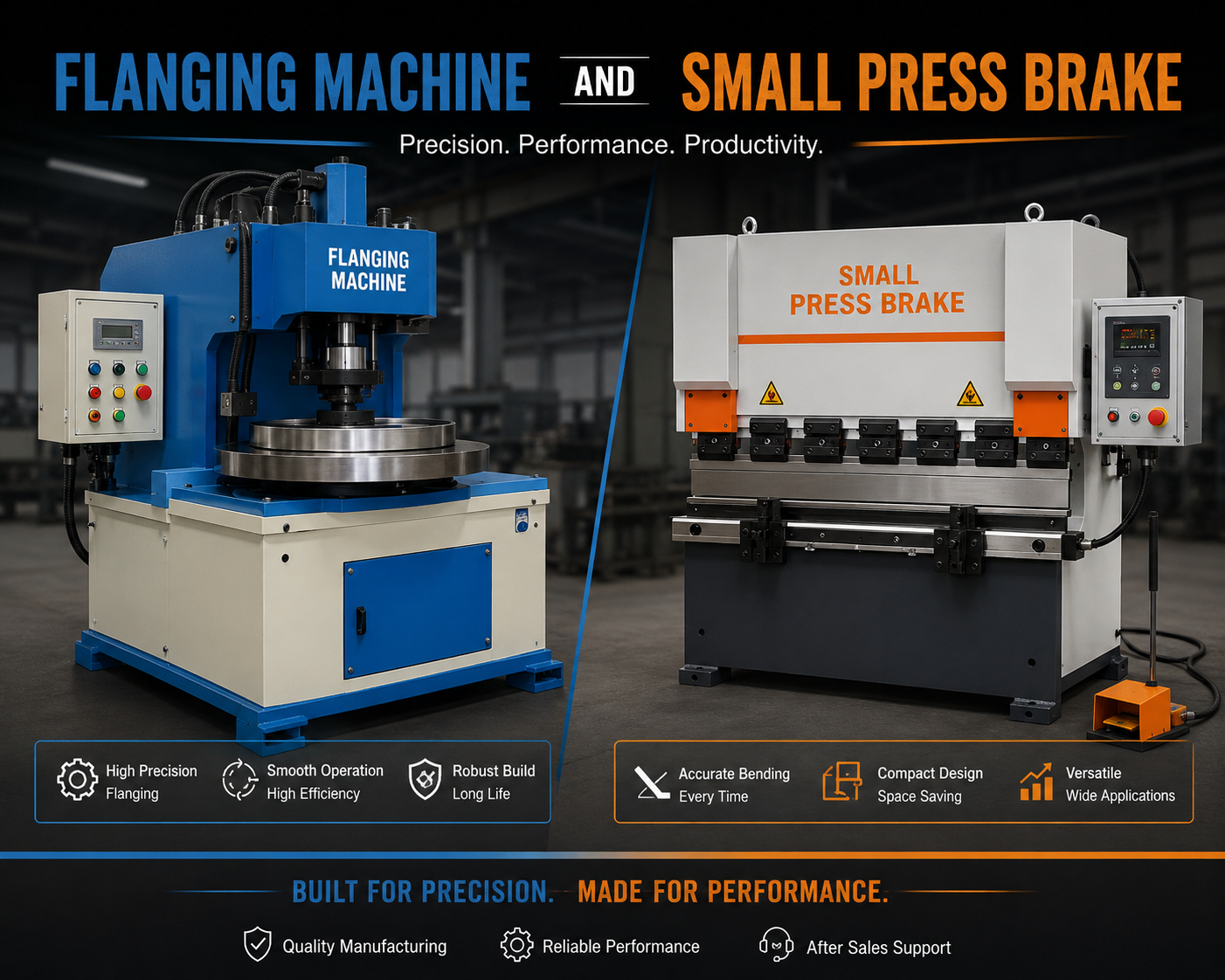
Modern sheet metal manufacturing depends on forming equipment that can shape metal accurately, repeatedly, and with minimal material waste. Two important machines used across fabrication workshops, HVAC production, automotive component manufacturing, electrical enclosures, ducting, stainless-steel fabrication, and general engineering are the Flanging machine and small press brake.
Although both machines manipulate sheet metal, they perform very different jobs. A Flanging machine primarily creates flanges around edges, openings, circular parts, or formed components, while a small press brake bends sheet metal along controlled straight lines. Understanding their capabilities helps manufacturers select the right technology for productivity, precision, and production flexibility.
What Is a Flanging Machine?
A Flanging machine is specialised metal-forming equipment designed to bend or turn the edge of a sheet, plate, tube, circular blank, or fabricated component. The process creates a flange that may improve structural strength, provide a joining surface, support welding, or enable assembly with another component.
Flanging can be performed on straight, curved, circular, or irregular edges depending on machine design and tooling.
Typical applications include:
- HVAC ducts and ventilation components
- Tanks and pressure vessels
- Metal containers
- Automotive components
- Industrial drums
- Pipe and tube components
- Stainless-steel kitchen equipment
- Electrical and mechanical enclosures
- Aerospace sheet metal components
Rather than simply bending a complete workpiece, flanging concentrates deformation near an edge or opening.
How Does a Flanging Machine Work?
A Flanging machine applies controlled mechanical force to reshape the edge of a workpiece without unnecessarily deforming the remaining material. Depending on the equipment, forming may be achieved through rollers, dies, hydraulic pressure, mechanical movement, or CNC-controlled tooling.
The basic process generally involves:
- Positioning the sheet or component securely.
- Aligning the required edge with the forming tooling.
- Applying controlled forming pressure.
- Gradually creating the required flange angle.
- Checking dimensions, radius, and flange consistency.
For circular components, rollers may progressively form the edge as the component rotates. This gradual forming method helps produce a uniform flange around the circumference.
Different Types of Flanging Operations
Flanging is not a single manufacturing technique. Different component geometries require different forming methods.
Edge Flanging
Edge flanging bends the outer edge of sheet metal to create a raised or angled section. It is widely used for strengthening components and producing joining surfaces.
Hole Flanging
Hole flanging forms material around a punched or prepared opening. The resulting collar can increase stiffness or provide additional surface area for fastening and assembly.
Circular Flanging
Circular flanging is particularly useful for tanks, ducts, vessels, pipes, and round sheet metal components. Specialised machines maintain consistent geometry while forming around the circumference.
What Is a Small Press Brake?
A small press brake is a compact sheet metal bending machine used to create accurate bends, folds, channels, brackets, boxes, and other fabricated profiles.
The machine normally uses a punch and die. Sheet metal is positioned between these tools, and controlled force pushes the material into the die to create the required bend.
Compared with large industrial press brakes, a small press brake provides a compact solution for workshops handling relatively short or lighter components.
Common products include:
- Metal brackets
- Electrical boxes
- Control panels
- Enclosures
- Small cabinets
- Machine guards
- Stainless-steel components
- Aluminium parts
- Custom fabrication components
- Prototype assemblies
Modern compact machines may include hydraulic, electric, servo-electric, or CNC-controlled systems.
How a Small Press Brake Performs Precision Bending
The bending process starts by selecting suitable punch and die tooling according to sheet thickness, material type, bend angle, and required radius.
The operator then positions the sheet against the back gauge. When the machine cycle begins, the punch moves towards the die and applies pressure to the material.
Important bending parameters include:
- Material thickness
- Tensile strength
- Bend allowance
- Bend deduction
- Inside bend radius
- Die opening
- Punch radius
- Required bending angle
- Springback compensation
Accurate adjustment of these variables is critical because metals such as stainless steel, mild steel, copper, and aluminium respond differently during bending.
Flanging Machine vs Small Press Brake
Despite both being sheet metal forming machines, their primary functions differ considerably.
| Feature | Flanging Machine | Small Press Brake |
| Primary process | Edge forming and flanging | Straight-line bending |
| Typical geometry | Straight, curved or circular edges | Straight bends |
| Common components | Tanks, ducts, vessels, circular parts | Brackets, boxes, panels |
| Tooling | Rollers or specialised forming dies | Punch and die |
| Best application | Edge preparation | General sheet bending |
| Production flexibility | Application-specific | Highly versatile |
| Typical workshop role | Specialised forming | General fabrication |
A fabrication company may therefore use both machines rather than treating one as a replacement for the other.
Benefits of Using a Flanging Machine
A correctly selected Flanging machine can improve production quality while reducing dependence on labour-intensive edge-forming methods.
Important advantages include consistent flange profiles, improved repeatability, controlled edge deformation, faster processing of circular parts and cleaner preparation for welding or assembly.
Flanges can also increase the rigidity of sheet metal components. This allows manufacturers to improve structural performance without always increasing material thickness.
Automated machines further improve repeatability when identical components are produced in medium or high volumes.
Advantages of a Small Press Brake
A small press brake is particularly valuable for manufacturers requiring flexibility without investing floor space in a large-capacity machine.
Its benefits can include:
- Compact machine footprint
- Accurate bending
- Quick tooling changes
- Lower energy requirements on certain models
- Suitability for prototypes and short production runs
- Easy production of custom components
- Reduced handling of smaller workpieces
- CNC programming options
Small fabrication companies can use one machine to manufacture many different products simply by changing tooling and bending programmes.
Factors to Consider When Choosing Metal Forming Equipment
Machine selection should begin with the actual production requirement rather than simply comparing machine prices.
Consider the following:
- Maximum material thickness
- Material tensile strength
- Maximum workpiece dimensions
- Required bending or flange geometry
- Production volume
- Accuracy requirements
- Tooling availability
- Automation requirements
- Operator skill level
- Maintenance and technical support
For a small press brake, bending force or tonnage is especially important. Insufficient capacity can cause poor bends or machine overload.
For flanging equipment, manufacturers should carefully assess component diameter, flange height, material thickness, forming radius, and required production speed.
Applications in Modern Manufacturing
The combination of a Flanging machine and small press brake can create an efficient sheet metal production workflow.
For example, a ventilation manufacturer may use a press brake to produce rectangular duct sections and brackets while using flanging equipment to prepare circular duct edges for joining.
Similarly, a tank manufacturer may cut and roll metal plates before using flanging equipment to prepare edges for assembly. Smaller brackets, supports, covers, and mounting components can then be produced using the press brake.
This complementary approach helps manufacturers perform multiple forming operations while maintaining dimensional consistency.
Frequently Asked Questions
What is the main purpose of a flanging machine?
A Flanging machine forms sheet metal edges or openings to create flanges used for reinforcement, joining, welding, or assembly.
Can a flanging machine process stainless steel?
Yes. Suitable machines can process stainless steel, provided their capacity and tooling match the material thickness and strength.
What is a small press brake used for?
A small press brake creates precise straight bends in sheet metal for brackets, boxes, panels, enclosures, channels, and fabricated components.
Is a small press brake suitable for a small workshop?
Yes. Its compact dimensions make it particularly suitable for workshops with limited production space.
What materials can a press brake bend?
Common materials include mild steel, stainless steel, aluminium, brass and copper, subject to machine capacity and suitable tooling.
Can a press brake make flanges?
A press brake can create some straight-edge flanges, but specialised flanging equipment is more suitable for many circular, curved, or complex flange operations.
What determines press brake tonnage?
Required tonnage depends mainly on material type, sheet thickness, bend length, die opening, and bending method.
What is springback in sheet metal bending?
Springback occurs when metal partially returns towards its original position after forming pressure is removed.
Are CNC controls useful for small press brakes?
Yes. CNC systems can improve repeatability, back-gauge positioning, angle control, programme storage, and production efficiency.
Which machine is better for circular components?
A Flanging machine designed for circular forming is normally more appropriate for tanks, round ducts, vessels, and similar components.
Can both machines be used in one production line?
Yes. They frequently complement each other because one specialises in flange formation while the other handles general bending operations.